
The short version
- Two high tides and two low tides a day, six hours apart.
- East coast: the sea goes out 200 to 500 metres.
- Northern tip: it barely moves, and you can swim all day.
- The swim window shifts 50 minutes later each day.
- Reef shoes are not optional on the east coast.
- Every hotel reception has the week's tide table.
What the tide does, coast by coast
The tidal range is not the same all the way around the island, and the difference between the north and the east is not a matter of degree. It is the difference between two entirely different beach holidays sold under the same name.
Nungwi and Kendwa, the northern tip
Range 1 to 1.5 mTidal range
1 to 1.5 m
Sea retreats
20 to 40 m
You can swim
Any hour of the day
What the beach becomes at low water
Very little changes. The water pulls back a few dozen metres and the beach gets wider. There is deep water within swimming distance at every state of the tide, which is why almost every resort brochure photograph of Zanzibar is taken here.
Verdict
The one part of the island where you can ignore the tide entirely. It is also the busiest, and the two facts are related.
Two high tides and two low tides a day, about six hours apart, shifting roughly fifty minutes later each day. Spring tides around the full and new moon push the range to its maximum.
Paje, Jambiani, Bwejuu and the south east
Range 3 to 4 mTidal range
3 to 4 m
Sea retreats
200 to 500 m
You can swim
Roughly two hours either side of high water
What the beach becomes at low water
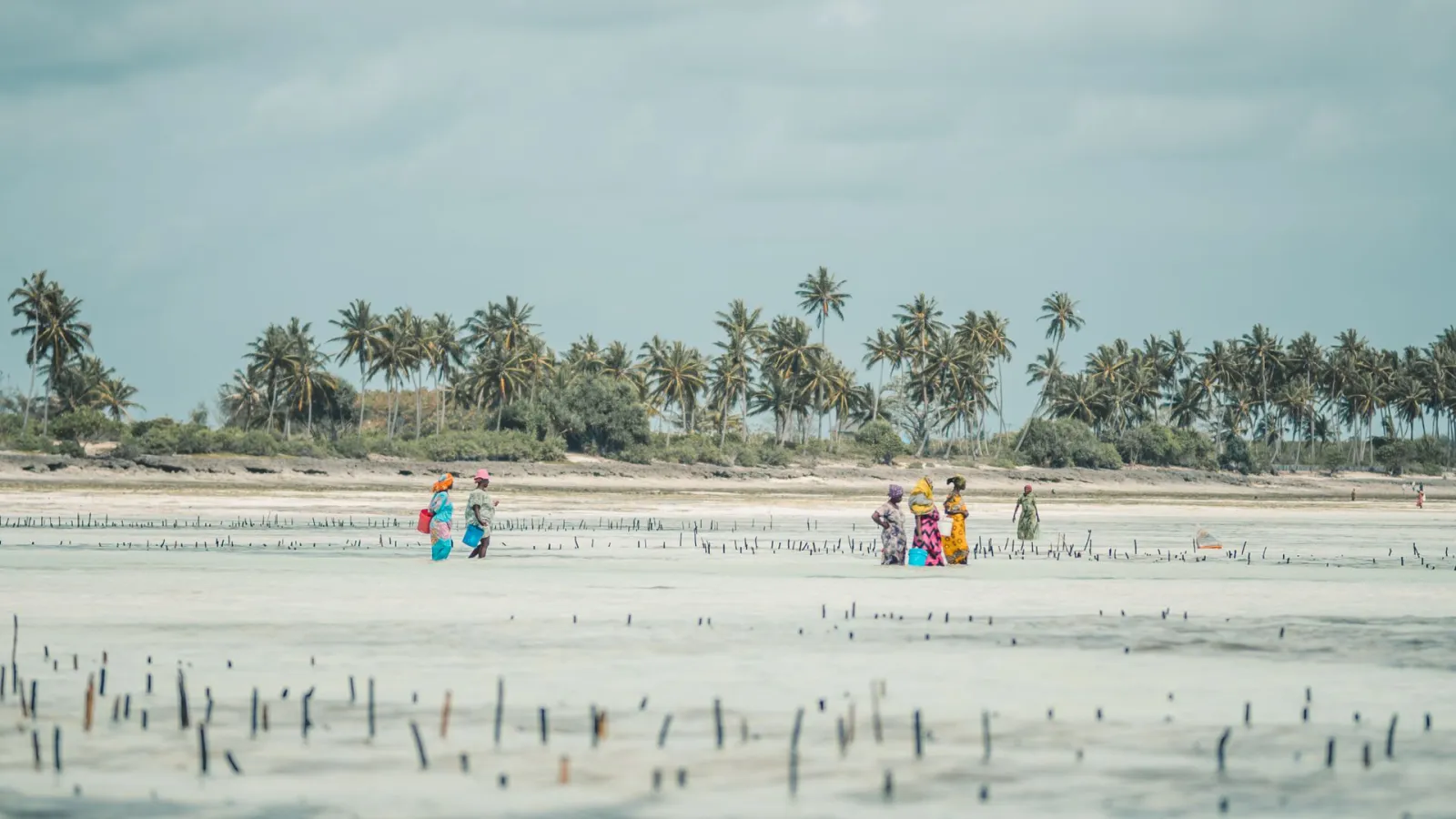
The lagoon empties completely. What is left is a vast flat of wet sand, coral rubble and tidal pools, with the reef break visible on the horizon. Villagers walk out to tend the seaweed lines and collect octopus. It is remarkable to look at and impossible to swim in.
Verdict
Spectacular twice a day and unswimmable twice a day. Bring reef shoes, and plan the swimming around the tide table rather than the other way round.
Two high tides and two low tides a day, about six hours apart, shifting roughly fifty minutes later each day. Spring tides around the full and new moon push the range to its maximum.
Matemwe, Kiwengwa and Pongwe
Range 2.5 to 3.5 mTidal range
2.5 to 3.5 m
Sea retreats
100 to 300 m
You can swim
Three to four hours around high water
What the beach becomes at low water
The same emptying as the east coast, slightly less extreme and varying a lot between hotels. Pongwe in particular sits in a pocket of reef that holds water when the beaches either side of it do not, which is why it keeps appearing in recommendations.
Verdict
Check the specific hotel rather than the coast. A kilometre along this shore can be the difference between swimming all day and swimming at four in the afternoon.
Two high tides and two low tides a day, about six hours apart, shifting roughly fifty minutes later each day. Spring tides around the full and new moon push the range to its maximum.
Stone Town and the western shore
Range 2 to 3 mTidal range
2 to 3 m
Sea retreats
50 to 150 m
You can swim
Most of the day, but nobody swims here
What the beach becomes at low water
Mud and rubble along the town front, and the boats sit on the bottom in the harbour. This side of the island is not where you come to swim, so the tide matters for boat departures rather than for beach days.
Verdict
Only relevant because it sets the departure times of the boat trips. Safari Blue leaves on the tide, and that is not negotiable by the operator.
Two high tides and two low tides a day, about six hours apart, shifting roughly fifty minutes later each day. Spring tides around the full and new moon push the range to its maximum.
| Coast | Range | Sea retreats | You can swim |
|---|---|---|---|
| Nungwi and Kendwa, the northern tip | 1 to 1.5 m | 20 to 40 m | Any hour of the day |
| Paje, Jambiani, Bwejuu and the south east | 3 to 4 m | 200 to 500 m | Roughly two hours either side of high water |
| Matemwe, Kiwengwa and Pongwe | 2.5 to 3.5 m | 100 to 300 m | Three to four hours around high water |
| Stone Town and the western shore | 2 to 3 m | 50 to 150 m | Most of the day, but nobody swims here |
This is why two people can come back from Zanzibar with irreconcilable accounts of it. One stayed at Kendwa and swam whenever they felt like it. The other stayed at Jambiani, walked out of the hotel at two in the afternoon and found the sea half a kilometre away.
Why the sea goes so far out here
The vertical range is not extraordinary. Three to four metres is large but not remarkable, and plenty of coastlines have more. What is unusual is the ground it falls across.
A fringing reef sits offshore along the whole east coast, and between it and the beach lies a shallow platform of sand and coral that is almost perfectly flat and sometimes half a kilometre wide. Drop the water three metres over ground with that little gradient and you expose an enormous area.
The northern tip has no such platform. The seabed falls away close to shore, so the same three metres of water moves the edge of the sea by a few dozen metres and no more.
It is also the gap with the other Indian Ocean islands: about 1 to 1.5 m in the Seychelles and under a metre in Mauritius, which is why we put the tide in our Zanzibar vs Seychelles vs Mauritius comparison.
What low tide is actually for
Treating low water as dead time is the mistake. It is when the east coast becomes interesting rather than merely pretty.
The seaweed farms come out of the water, and the women who work them walk out to the lines. It is the island's largest employer of womenand it happens on a schedule set by the moon. Watching it, and being shown it by someone doing it, is the best hour many visitors spend here.
The tidal pools left behind hold octopus, urchins, starfish and small reef fish, and the flats are walkable for a kilometre in reef shoes. Photographers get the mirror surface that every drone shot of Zanzibar depends on, and it only exists in the hour after the water leaves.
One caution. The coral rubble is sharp, sea urchins are common, and the incoming tide arrives across flat ground faster than people expect. Reef shoes and an eye on the water solve both.
How to plan around it
Get the tide table on your first morning. Reception has it printed, and it covers the week. That single piece of paper is what turns the tide from a disappointment into a schedule.
Then work backwards. Swimming and snorkelling go in the window around high water. Walking the flats, the seaweed farms and photographs go at low water. Boat trips leave on the tide whether it suits you or not, which is why Safari Blue departure times move through the week.
And if none of that appeals, stay on the northern tip. That is the honest answer for anyone whose idea of a beach holiday is walking out of the room and into the sea at any hour. It costs more and it is busier, and it buys you exactly that.
How to read a Zanzibar tide table
It is one sheet of paper and it takes thirty seconds to learn. Four lines a day: two high waters and two low waters, each with a time and a height in metres.
- Two highs and two lows a day, roughly six hours and twelve minutes apart. Zanzibar is semi-diurnal, which is why the pattern is so regular.
- Everything shifts about 50 minutes later each day. A high water at nine this morning is a high water at ten tomorrow, and by the end of a week it has walked right round the clock.
- The height column is the one people ignore. A 3.8 m high water and a 2.9 m high water are different afternoons on the east coast.
- Swim from two hours before high water to two hours after. That is the working rule on the east coast and it is close enough.
The drift is the part that catches people out on a week's stay. It means the good swimming window is a different time every day, and a hotel that was perfect on Monday afternoon has no water at all by Thursday afternoon.
| Day of your stay | Morning high water | Best swimming |
|---|---|---|
| Day 1 | 7.00 | First thing, then again around seven in the evening |
| Day 3 | 8.40 | Mid morning. The civilised version |
| Day 5 | 10.20 | Late morning into lunch |
| Day 7 | 12.00 | The middle of the day, which is also the hottest |
An illustration of the drift rather than a real week. Use the printed table at your hotel, which is calculated for your stretch of coast.
Spring tides, neap tides and the full moon
Twice a month, around the full moon and the new moon, the sun and the moon pull in line and the range goes to its maximum. Those are spring tides, and on the east coast they are the days the sea walks out furthest and comes back highest.
A week later, at the quarter moons, the two pulls partly cancel and the range is at its smallest. Those are neap tides, and they are the friendliest week to book on the east coast if you care about swimming.
Which tide each activity needs
| What | Tide | Why |
|---|---|---|
| Swimming, east coast | High | Two hours either side. Outside that there is no water to swim in. |
| Kitesurfing | Mid to high | Deep enough to ride, shallow enough to stand. See kitesurfing in Paje. |
| Walking the flats and seaweed farms | Low | The whole lagoon becomes walkable. Reef shoes, always. |
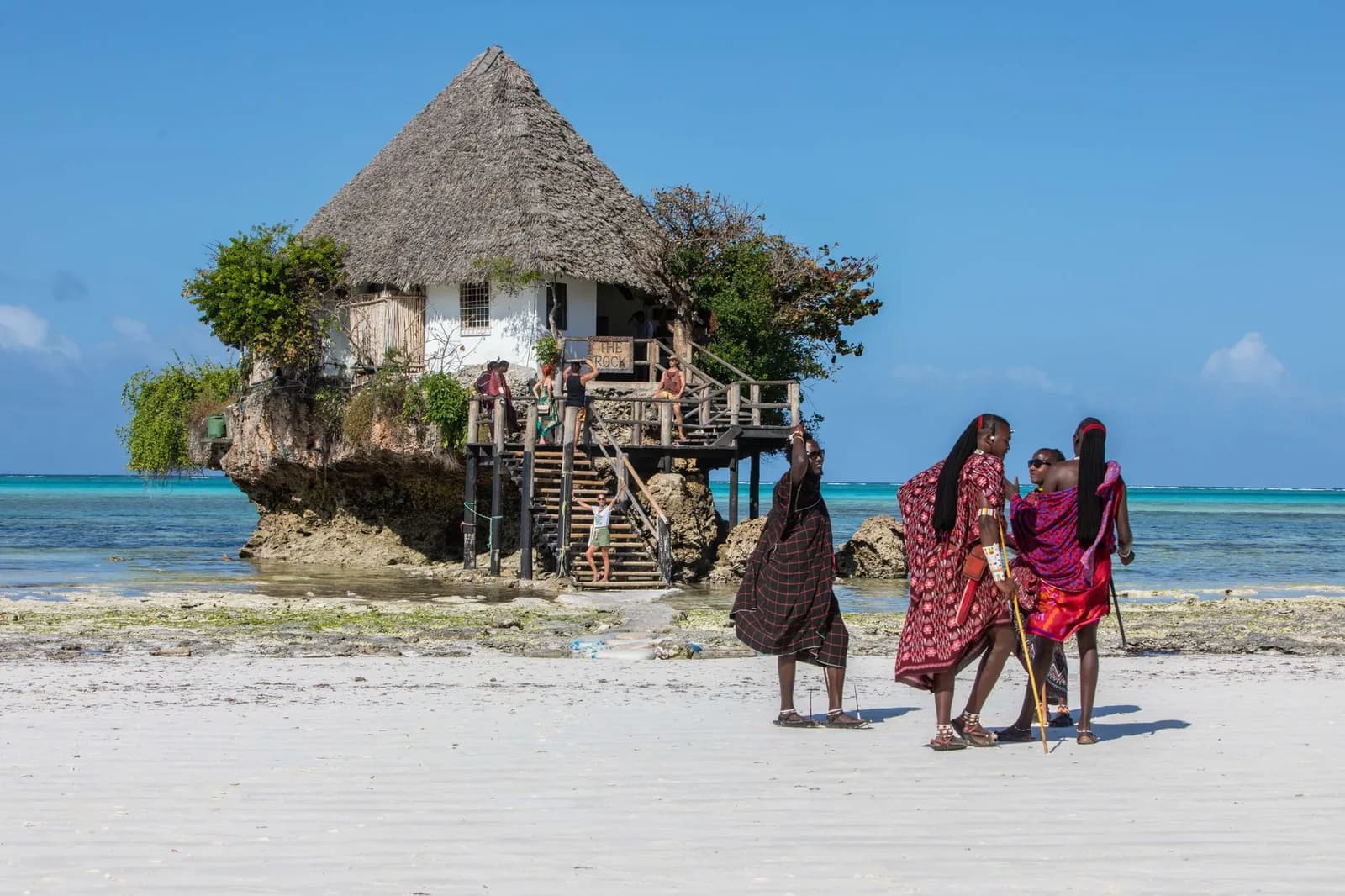
| The Rock restaurant | Either | Walk out at low, take the boat at high. Two different photographs. See The Rock. |
| Safari Blue and the sandbanks | Falling | The sandbank only exists once the water drops, and the channel out of Fumba needs depth. This is why departures move. |
| Mnemba snorkelling | Any | The atoll is offshore and deep. The hour of the day matters far more than the tide. |
| Swimming, northern tip | Any | Nungwi and Kendwa have deep water off the sand at every hour. That is the whole reason they cost more. |
Careful
Questions people ask about Zanzibar tides
How far does the tide go out in Zanzibar?
On the east coast, between two hundred and five hundred metres, twice a day. On the northern tip around Nungwi and Kendwa, a few dozen metres. Same island, entirely different holiday, and it is the single biggest thing separating one beach from another here.
Which beach in Zanzibar is best for swimming at low tide?
Nungwi and Kendwa, on the northern tip. The shelf drops away close to shore, so there is swimmable water at any state of the tide. Everywhere on the east and north east coasts empties out to some degree.
Why does the tide go out so far on the east coast?
A wide, shallow reef platform sits between the beach and the outer reef, sometimes several hundred metres of it. A three metre vertical fall across ground that flat exposes an enormous area. The tide is not unusually large, the ground is unusually flat.
When is high tide in Zanzibar?
There are two high tides a day, roughly twelve hours apart, and they shift about fifty minutes later each day. That means the good swimming window walks steadily through the day over a week's stay. Every hotel has a printed tide table at reception, and it is the most useful piece of paper on the island.
What are spring tides in Zanzibar?
The two periods a month, around the full moon and the new moon, when the sun and moon pull in line and the tidal range reaches its maximum. On the east coast that means the sea goes out furthest and comes back highest. At the quarter moons the range is at its smallest, which is the easier week for swimming.
Does the tide affect boat trips in Zanzibar?
Yes, and it is why departure times move through the week. Safari Blue cannot leave the shallow channel at Fumba on a low tide, and the sandbanks it visits only exist once the water has dropped. Confirm your departure the evening before rather than trusting a time you were given weeks earlier.
Can you still enjoy the east coast beaches?
Yes, and plenty of people prefer them. The tide is a rhythm rather than a problem once you know about it: swim in the morning window, walk out on the flats in the afternoon, and the beach is emptier and cheaper than the north all week. What ruins the trip is arriving without knowing.