
Real name
Hamad bin Muhammad el-Murjebi
Born
Zanzibar, around 1832 to 1837
Died
Stone Town, mid-June 1905
Trade
Ivory and enslaved people
Power base
Kasongo, eastern Congo
His house
Shangani, Stone Town, not open as a museum
Who was Tippu Tip?
Tippu Tip was the most powerful ivory and slave trader of 19th century East and Central Africa. Born in Zanzibar in the 1830s, he led armed caravans from the Swahili coast deep into the Congo, ruled a domain of his own around Kasongo, and in 1887 was made governor of the Stanley Falls district by King Leopold II. He retired to Stone Town rich, and died there in 1905.
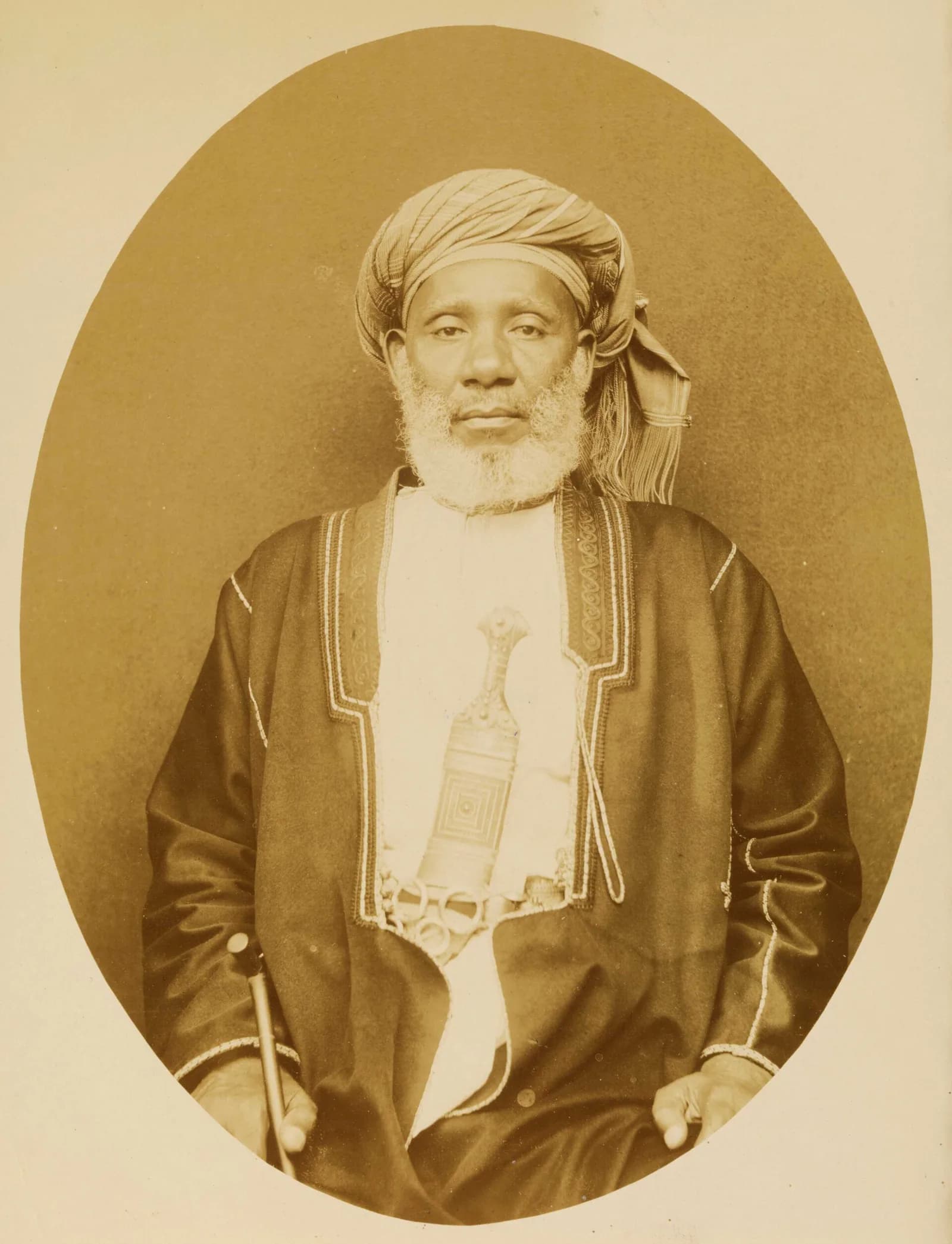
He matters for anyone visiting Stone Town because he is the town's prosperity and its crime in one man. The ivory his caravans carried and the people they enslaved paid for clove plantations on the island and for townhouses like his own. The explorers who crossed Africa in the 1870s, Livingstone, Cameron and Stanley, all depended on him at some point, and wrote about him with a respect that sits badly today.
What does the name Tippu Tip mean?
It is a nickname, and nobody agrees on it. Tippu Tip said himself that it came from the "tip-tip" of his men's guns. Sidney Hinde, a British doctor who served the Congo Free State, translated it as "the gatherer together of wealth", and other accounts tie it to a twitch of his eyes. You will also see Tippu Tib, the spelling Britannica uses, and Tippoo Tib in older English books. His real name was Hamad bin Muhammad bin Juma bin Rajab el-Murjebi.
Tippu Tip's family, ethnicity and religion
He was of mixed Arab and Swahili descent, like most of Zanzibar's merchant class. According to Heinrich Brode, who took down his story, his mother came from a respected Muscat family of the Wardi clan, and his father's side were Arab traders long settled on the coast and in the caravan trade. One great-grandmother was African, from Mbwa Maji, south of Dar es Salaam. He was a Muslim, and spoke Swahili and Arabic.
Tippu Tip and the East African ivory and slave trade
The two trades were one business. Europe and America wanted ivory for piano keys, billiard balls and combs, and the herds near the coast had been shot out by mid-century, so the caravans went further inland every decade. There were no roads and no pack animals that survived the tsetse fly, so the tusks went to the coast on the heads of porters, many of them captives taken on the way and sold once the march was over.
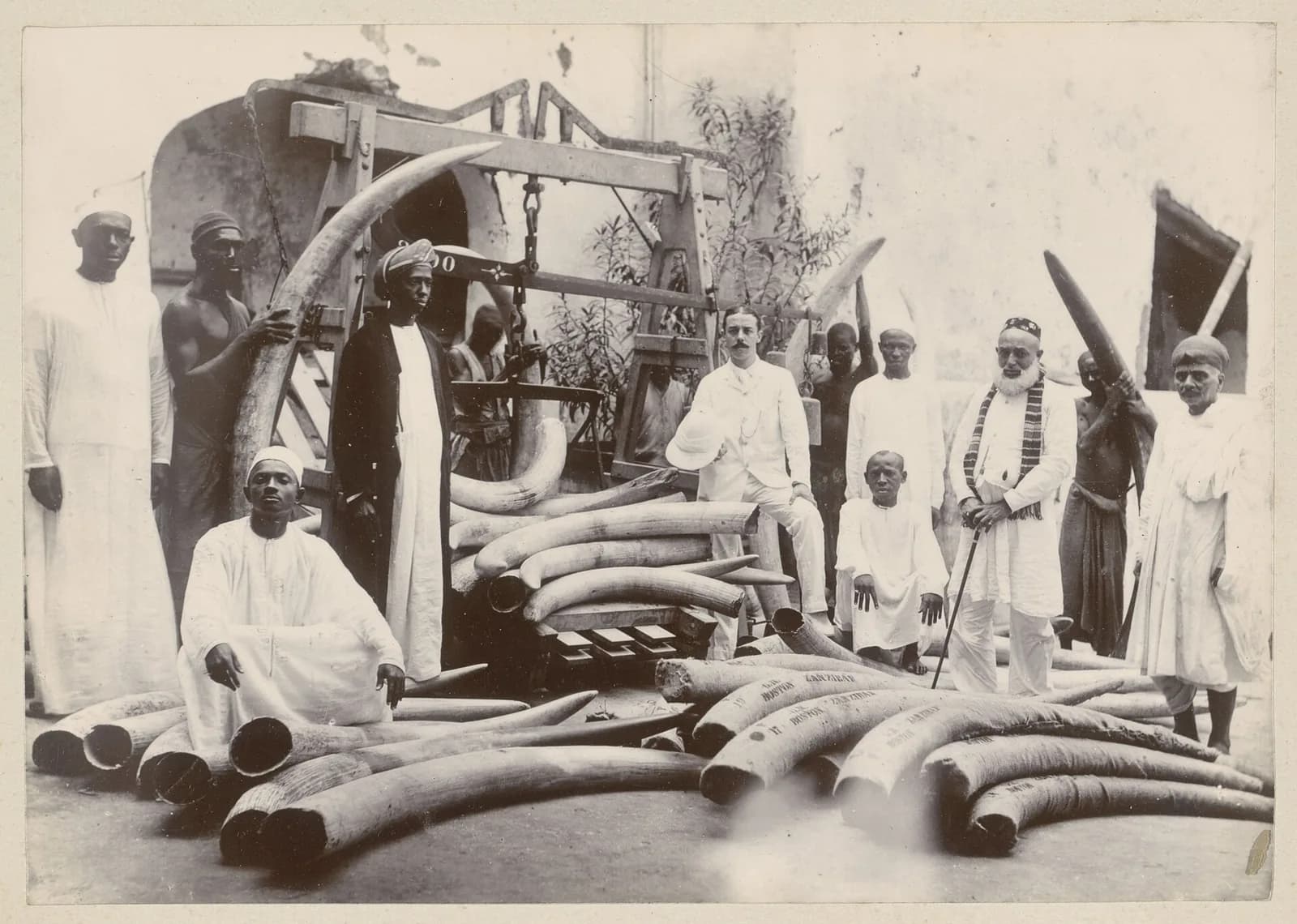
Tippu Tip's method was force first and trade second. His early campaigns, as he told them, read as a list of villages attacked, chiefs deposed and captives taken: hundreds at a time, from Unyanyembe in what is now Tanzania to the lands south of Lake Tanganyika. In the Congo he went further, playing local rulers against each other until he governed the region himself, with outposts collecting ivory as tribute.
The captives who reached the coast were sold through the Stone Town slave market, mainly to the clove plantations of Zanzibar and Pemba, which ran on enslaved labour. Tippu Tip bought into them himself. The historian Abdul Sheriff found that he owned no plantation when he left for the mainland, and that by 1895 he had seven plantations and 10,000 slaves. It is one historian's count, repeated everywhere since, and the only figure on record.
Zanzibar was the banker and the market of this trade. Indian financiers in Stone Town advanced the trade goods, the caravans left from the mainland opposite, and the ivory and the people came back through the island. That is why the town looks the way it does, and why its former slave market is the first thing to see there.
Tippu Tip's House in Stone Town: can you visit it?
Not as a museum, but you can see it. The house where Tippu Tip lived and died stands in Shangani, on the western tip of Stone Town, in the lane locals call Suicide Alley, close to the Africa House Hotel and the Serena. There is no ticket, no opening hours and no exhibition inside.
Where is Tippu Tip's House?
South of Kelele Square, about 15 minutes on foot from Forodhani gardens and the Old Fort. Ask anyone in Shangani for Tippu Tip: the house is known. Its neighbour is Tatu, a three floor pub and restaurant with a rooftop, which our Zanzibar food guide lists for sunset.
What you can see from the street
Stop for the large carved wooden door, one of the finest merchant doors in a town known for them, the black and white marble steps in front of it and the information plaque on the wall. The rest of the building is tired: the house stayed a private residence until the 1964 revolution, was then split into flats, and has not been restored. A guide quoted on its Wikipedia page called it "the most magnificent squat in all of Africa".
Is Tippu Tip's House open to visitors?
No. Residents sometimes invite visitors in, and travellers who went inside describe a dark first floor with tall arches. If you are invited, it is a private home and a small tip is the polite answer. Some will tell you of a tunnel used to move slaves from the seafront: we have found no source for it, and similar stories are told about several houses in town.
A plan to restore the house as it was in 1905 and open a museum of Tippu Tip and the slave trade has been published by heritage campaigners. We found no sign that work has started. If you have been inside recently or see scaffolding, tell us through the contact page. Last checked 23 October 2026.
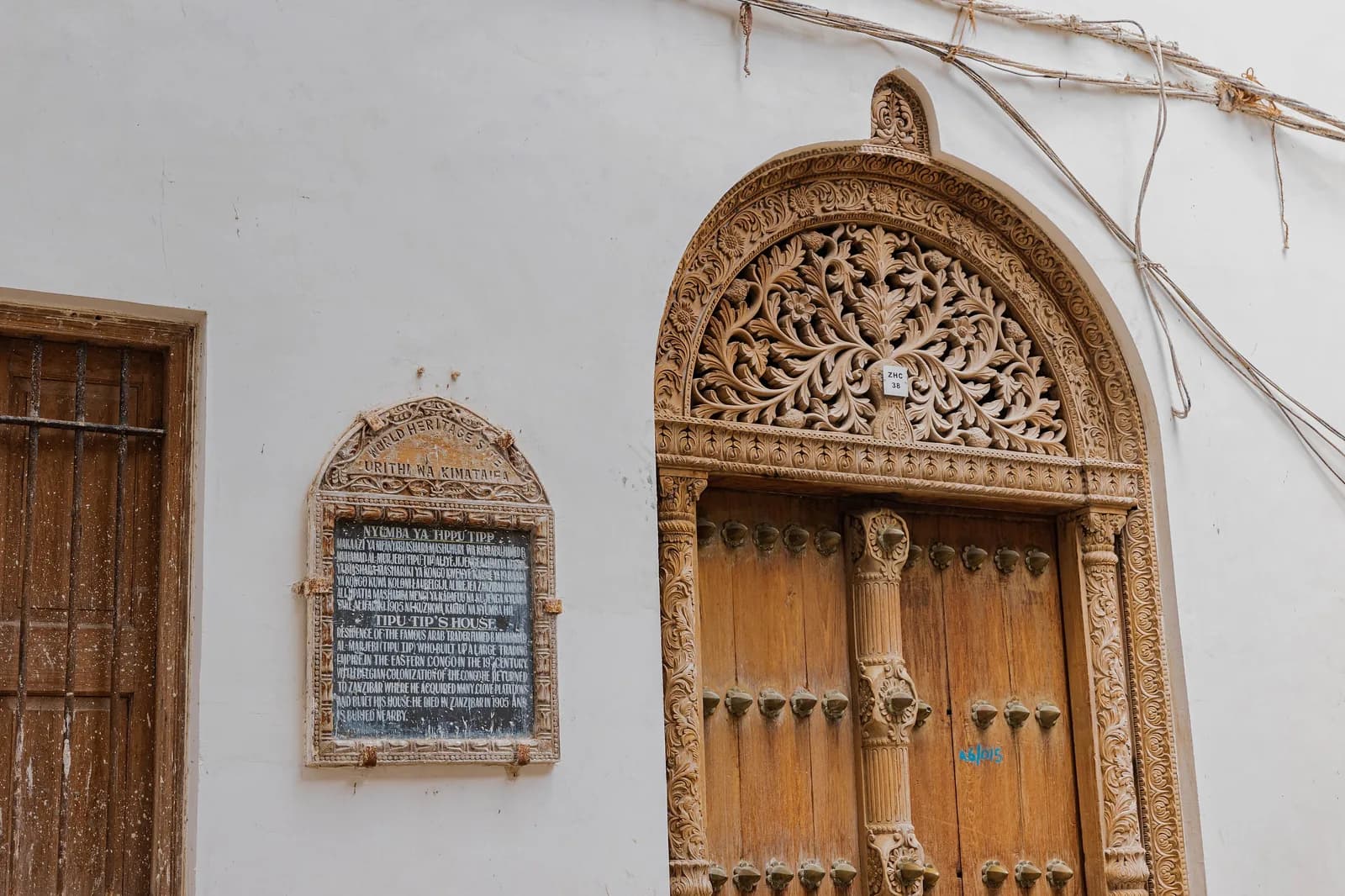
Looking at the house
- Go in the late afternoon, on the way to a sunset drink at Tatu or Africa House.
- Ask before photographing people on the steps: they live there.
- Do the slave market first. The house means more once you have stood in the holding chambers.
Tippu Tip timeline, from Zanzibar to the Congo and back
The dates that sources agree on, and the ranges where they do not.
- c. 1832 to 1837
- Born in Zanzibar into a family of coastal Arab and Swahili traders. Sources disagree on the year.
- Late 1850s
- Leads his first caravan inland, about 100 men, toward what is now central Tanzania, looking for ivory and captives.
- 1867
- Campaigns south of Lake Tanganyika and meets David Livingstone, who calls him "Tipo Tipo" in his journals.
- 1870s
- Builds his own domain on the upper Congo, with Kasongo as its capital from about 1875.
- 1876
- Escorts Henry Morton Stanley from Nyangwe down the Lualaba for several weeks, then turns back.
- 1884 to 1887
- Claims the eastern Congo for himself and for Sultan Barghash of Zanzibar.
- 24 Feb 1887
- Accepts the post of governor of the Stanley Falls district for King Leopold II's Congo Free State, and supplies men for Stanley's Emin Pasha expedition.
- 1890
- Leaves the Congo for good. By 1891 he is back in Zanzibar, an adviser to the sultan, and never travels inland again.
- 1892 to 1894
- The Congo Arab War. His son Sefu bin Hamid fights the Free State and is killed on 20 October 1893.
- 1895
- Owns, by Abdul Sheriff's count, seven plantations and 10,000 slaves on Zanzibar.
- 1897
- Zanzibar abolishes the legal status of slavery, under British pressure.
- June 1905
- Dies of malaria in his house in Stone Town, on 13 or 14 June depending on the source, aged about 68.
Tippu Tip's state in the Congo, Stanley and King Leopold
By the late 1870s Tippu Tip ruled a stretch of the upper Congo from Kasongo, in today's Maniema province of the Democratic Republic of the Congo. He held it in the name of the Sultan of Zanzibar and in practice for himself. It was not a state with borders, but a network of armed posts and allied chiefs that sent ivory east.
That made him the man European explorers had to deal with. He met Livingstone in 1867, helped the British officer Verney Lovett Cameron in the 1870s, and in 1876 escorted Stanley from Nyangwe down the Lualaba before turning back, which allowed Stanley to follow the river to the Atlantic.
Ten years later the same Stanley came to Zanzibar with an offer from King Leopold II. On 24 February 1887 Tippu Tip agreed to govern the Stanley Falls district, the station that became Stanleyville and is now Kisangani, for the Congo Free State. Leopold wanted the Arab traders held in check. Tippu Tip wanted his trade protected. Britannica notes that the Europeans gave him the title without the weapons to enforce it, and he left in April 1890.
The Emin Pasha Relief Expedition
The same contract had him supply porters for Stanley's expedition to "rescue" Emin Pasha, the governor of Equatoria cut off by the Mahdist rising in Sudan. The expedition's rear column, left at Yambuya to wait for those men, was almost wiped out by disease and violence. Stanley blamed Tippu Tip for the delay. Historians since have been less sure, and in Britain the scandal ended up hurting Stanley more than him.
The Congo Arab War after he left
With Tippu Tip gone, his son Sefu bin Hamid and the trader Rumaliza fought the Free State from 1892. The Belgian commander Francis Dhanis won with armies made up, on both sides, mostly of African soldiers. Sefu was killed on 20 October 1893, and by 1895 the Arab-Swahili hold on the eastern Congo was over, replaced by Leopold's regime, which would prove no kinder.
Why Tippu Tip is controversial: merchant prince or slaver
For decades European writers presented him as a charming, capable merchant prince: Stanley admired him, and a 2023 study of the literature found that his European image moved only slowly from "the most remarkable man among Arabs" to "renowned slave trader". His own memoir, which tells raids as adventures, helped the first version.
There is no real dispute about the facts. He enslaved people on a vast scale, his campaigns killed thousands, and his wealth was built on both. The arguments are elsewhere: about how much the European powers that used him and then replaced him share the blame, and about how Zanzibar, whose old town was paid for by this trade, should tell the story.
He also left something less obvious. The caravan routes he ran are a large part of why Swahili is spoken in the eastern Congo today, and why Islam reached Maniema. In Stone Town his house carries an information plaque, and that is all: no museum tells his story.
On guided tours
Guides sometimes tell Tippu Tip's life as a rags to riches adventure. If the story you hear leaves out who carried the ivory, ask. A good guide will tell you.
Where to see Tippu Tip's traces in Stone Town
Apart from the plaque on his door, nothing in Stone Town carries his name, but five stops in about an hour and a half tell his story in the right order: the market his captives were sold in, the sultan he served, the house he died in. The timings are ours.
Former slave market and Christ Church
45 minutes · $10, guide included
The market that sold the people caravans like his brought to the coast. The holding chambers under the old mission and the cathedral built on the site after the market closed in 1873.
Darajani and the walk west
10 minutes · Free
Cut through the lanes toward the seafront. Darajani market is where the town still trades, on the edge of the old merchant quarter.
The House of Wonders, outside
10 minutes · Free, from the street
Built for Barghash in 1883, the sultan Tippu Tip claimed the Congo for. Its museum once hung his best known portrait. Closed since the 2020 collapse.
Tippu Tip's House, Shangani
10 minutes · Free, from the street
The carved door and the black and white marble steps. Look, do not walk in uninvited: people live there.
A drink at Tatu, next door
As long as you like · $15 to $30 for a meal
Three floors and a rooftop beside the house. The easiest way to sit and look at the street he lived on.
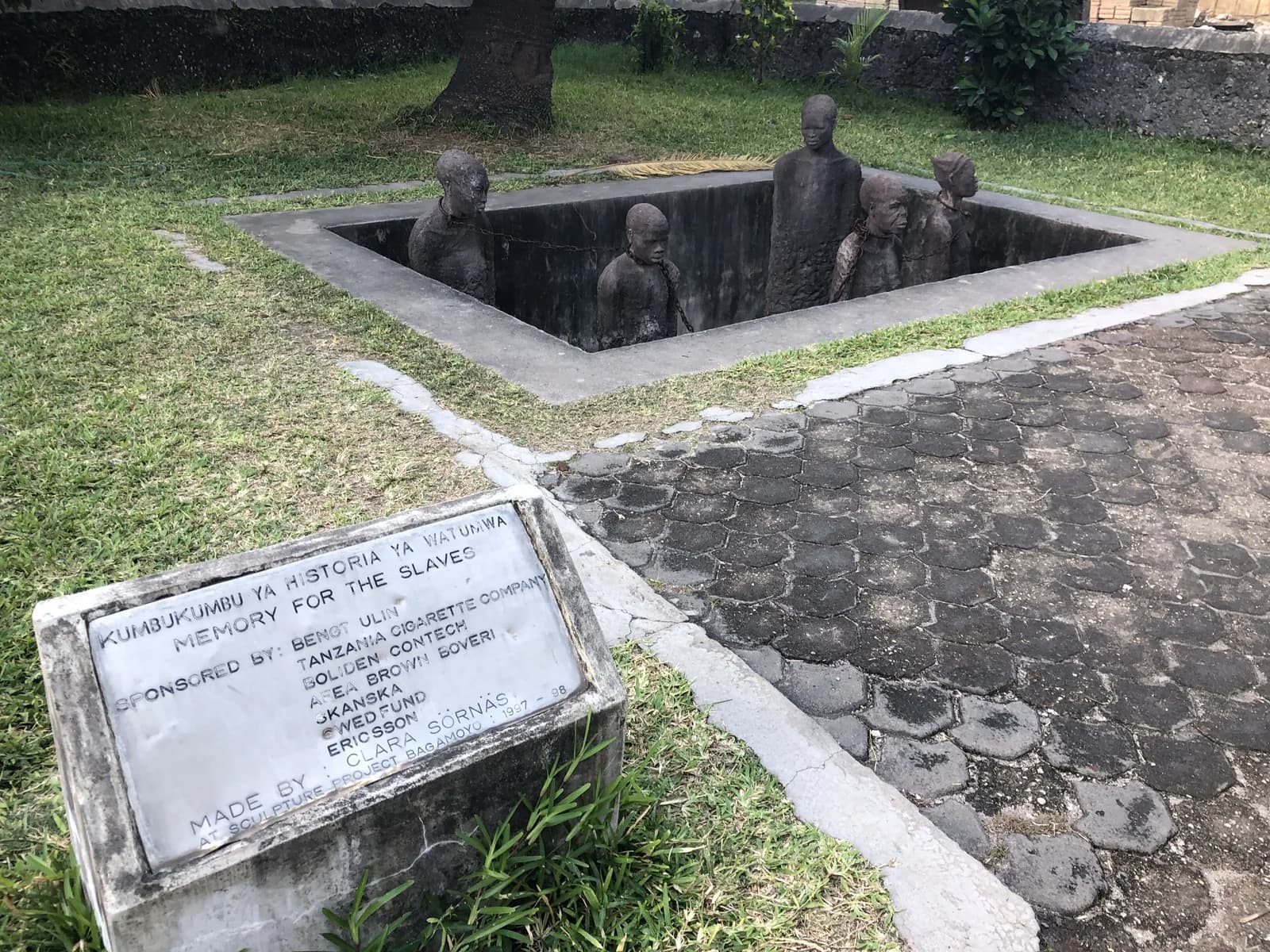
The portrait the House of Wonders used to show is not on display while the building is closed. Our House of Wonders page follows the rebuilding, and the Anglo-Zanzibar War page covers the seafront palaces of the sultans he served, shelled in 1896 while he was still alive in Shangani. Outside Zanzibar, his traces are in the eastern Congo, at Kasongo and Kisangani, where no site is set up for visitors.
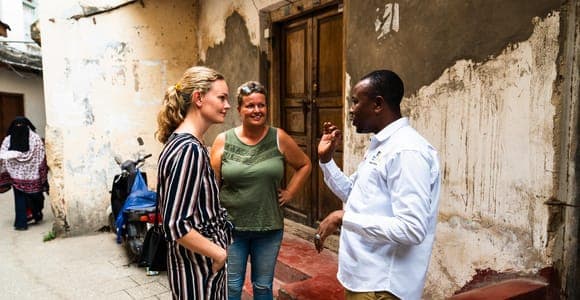
A Stone Town history tour with a guide
A guide gets you into the slave market chambers with the context and through the lanes to Shangani without a wrong turn. Check that the slave market entry is included. Prices and ratings are as the partner lists them, read on the date shown below the card.
Stone Town: guided history walk
The slave market memorial, the palaces and the Freddie Mercury house.
From$25per person
Check availabilityPrices, ratings and review counts read from GetYourGuide on 27 September 2026, and indicative. These are partner links: the price is the same for you.
Who stopped slavery in Zanzibar?
It ended in three steps, each forced by Britain. On 5 June 1873 Sultan Barghash signed a treaty closing the Stone Town slave market and banning the sea trade. The Anglican mission bought the site and built Christ Church on it, with the altar where the whipping post stood. The caravans Tippu Tip ran inland carried on for years after that, since the treaty did not touch the mainland trade or slavery on the island.
In 1897 a decree abolished the legal status of slavery on Zanzibar and Pemba, though enslaved people had to apply to be freed and many did not. The last forms ended in 1909. Tippu Tip lived to see the market close and the law change, and kept his plantations. The full visit to the market site is in our Stone Town guide.
Tippu Tip's autobiography and the books to read
In retirement Tippu Tip told his life in Swahili, written in Arabic script: the first autobiography in the Swahili language. The German consul Heinrich Brode, who knew him in Zanzibar, published the text and then a biography drawn from it in 1905, translated into English in 1907 as Tippoo Tib: The Story of His Career in Central Africa.
The version to look for is W. H. Whiteley's translation, Maisha ya Hamed bin Muhammed el Murjebi, yaani Tippu Tip, published with the Swahili text in 1958 to 1959. Read it knowing that it is his account: villages burned and people taken appear as victories. For the economic picture, Abdul Sheriff's Slaves, Spices and Ivory in Zanzibar (1987) explains the world he worked in, and the British diplomat Stuart Laing published a full biography of him in 2017.
Questions people ask about Tippu Tip
Who was Tippu Tip?
Tippu Tip, born Hamad bin Muhammad el-Murjebi in Zanzibar around 1832 to 1837, was the best known ivory and slave trader of 19th century East and Central Africa. His caravans reached the upper Congo, where he ruled a domain around Kasongo, and in 1887 King Leopold II made him governor of the Stanley Falls district. He retired to Stone Town and died there in June 1905.
What does Tippu Tip mean?
It is a nickname, and there are several explanations. Tippu Tip himself said it came from the tip-tip sound of his men's guns. Sidney Hinde, a British doctor who served the Congo Free State, translated it as the gatherer together of wealth, and other accounts link it to a twitch of his eyes. His real name was Hamad bin Muhammad bin Juma bin Rajab el-Murjebi.
What was Tippu Tip's ethnicity?
He came from a coastal Arab and Swahili family. His mother belonged to a Muscat family of the Wardi clan, his father's side were Arab traders long settled on the Swahili coast, and one of his great-grandmothers was African, from Mbwa Maji south of Dar es Salaam. He was born and died in Zanzibar.
What religion was Tippu Tip?
He was a Muslim, like the Omani and Swahili merchant class of Zanzibar he belonged to.
What was Tippu Tip's state?
A trading domain in the eastern Congo, centred on Kasongo in what is now Maniema province of the Democratic Republic of the Congo, which he built up from the 1870s. He held it nominally for the Sultan of Zanzibar. From 1887 to 1890 he also governed the Stanley Falls district, around present day Kisangani, for the Congo Free State.
Can you visit Tippu Tip's House in Stone Town?
Not as a museum. The house in Shangani has been divided into flats since the 1964 revolution and is in poor condition. You can see the carved wooden door and the black and white marble steps from the street, and residents sometimes invite visitors in, but there is no ticket, no opening hours and no exhibition.
Who stopped slavery in Zanzibar?
Sultan Barghash closed the Stone Town slave market on 5 June 1873, under a treaty forced by Britain. The legal status of slavery was abolished in 1897, also under British pressure, and the last forms of it ended in 1909. The Anglican cathedral now stands on the site of the market.
Did Tippu Tip write a book?
Yes. He dictated or wrote his memoirs in Swahili in Arabic script, the first autobiography in the language. The German consul Heinrich Brode published the text in the early 1900s and a biography based on it in 1905, translated into English in 1907 as Tippoo Tib. The edition most people read today is W. H. Whiteley's English translation, Maisha ya Hamed bin Muhammed el Murjebi, yaani Tippu Tip, from 1958 to 1959.
Where is Tippu Tip buried?
We have not found a reliable source for his grave. He died in his house in Stone Town in June 1905 and was presumably buried on the island, but no grave is marked as his on any walking tour we know of.
Sources: Wikipedia, articles on Tippu Tip, Tippu Tip's House and the Congo Arab War, and Britannica, read on 23 October 2026; Heinrich Brode's biography for his family and death. Abdul Sheriff for the 1895 plantation count, Antiquity (2020) on Kasongo, RUDN Journal of World History (2023) on his European image. The current state of the house, its owner and his grave are not documented in any dated source we could find.