Date
27 August 1896
Length
38 minutes, 09:02 to 09:40
Who won
Britain
Losses
About 500 Zanzibaris killed or wounded, one British sailor hurt
Where
The Stone Town seafront, Mizingani Road
Still standing
The House of Wonders, closed for rebuilding
The Anglo-Zanzibar War of 1896 in ten lines
The Anglo-Zanzibar War was a quarrel over a succession, settled by gunfire before most of Stone Town had finished breakfast. Times are local, as the British logs give them.
- 25 Aug, 11:40
- Sultan Hamad bin Thuwaini, who had worked with the British, dies suddenly in the palace.
- 25 Aug
- Within hours Khalid bin Barghash, 29, a son of the late Sultan Barghash, moves into the palace and claims the throne. The British, who want Hamoud bin Mohammed, say the treaty obliges any new sultan to have their consent.
- 25 Aug
- Khalid shuts himself in with about 2,800 men, most of them armed civilians, the palace guard and some artillery.
- 26 Aug
- British warships gather off the seafront, led by the cruiser St George of Rear Admiral Harry Rawson. Ultimatum: haul down the flag and leave the palace by 09:00 the next morning.
- 27 Aug, 08:00
- Khalid answers: "We have no intention of hauling down our flag and we do not believe you would open fire on us."
- 09:00
- The order to fire is given. At 09:02 the Racoon, Thrush and Sparrow open fire on the palace at close range.
- 09:05
- The sultan's only warship, the royal yacht Glasgow, fires on the St George. She is hit and sinks in the shallows in front of the palace.
- 09:10 to 09:30
- The palace, largely built of timber, catches fire. The Zanzibari guns fall silent. Khalid slips out of the back of the palace.
- 09:40
- The flag over the palace is shot down and the firing stops. About 500 shells have been fired, with 4,100 machine gun rounds and 1,000 rifle rounds.
- Afternoon
- Hamoud bin Mohammed is installed as sultan, with a government run in practice by the British.
Who won the Anglo-Zanzibar War?
Britain, without a contest. Khalid lost his palace, his yacht and his throne in under an hour, and the British put their man on the throne the same afternoon. Zanzibar had been a British protectorate since 1890; after 1896 the sultans reigned and the British consul governed.
How many people died in the 38 minute war?
About 500 Zanzibaris were killed or wounded, most of them in the fire that took the palace. Nobody knows how many of Khalid's 2,800 men actually fought. Looting broke out in the Indian quarter after the shelling and killed about 20 more, until 150 Sikh soldiers were brought in from Mombasa. On the British side, one petty officer on the Thrush was badly wounded, and he recovered.
Anglo-Zanzibar War sites in Stone Town: what you can still see
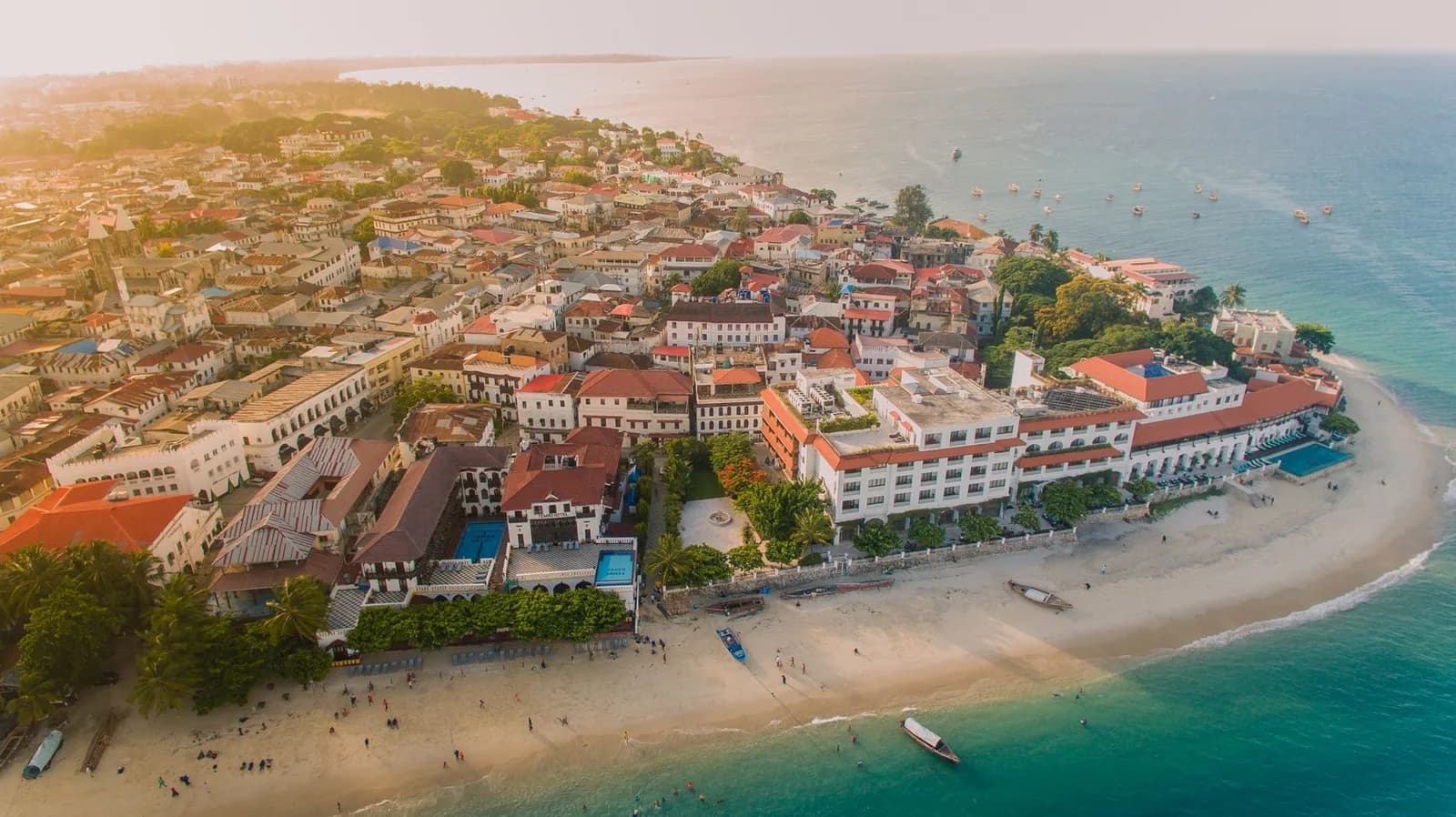
In 1896 the Stone Town seafront was one long row of royal buildings: the sultan's palace, the harem beside it, and the House of Wonders, joined by covered wooden bridges above the street. They were built largely of local timber, for show and for comfort, and not one of them was built to take a shell.
Walk along Mizingani Road today and you are on the same line. What has changed is what stands on it. We checked each site against the record, and the honest answer is that almost nothing you see was there that morning. The walk is about reading what replaced it.
The Palace Museum: not the palace that was shelled
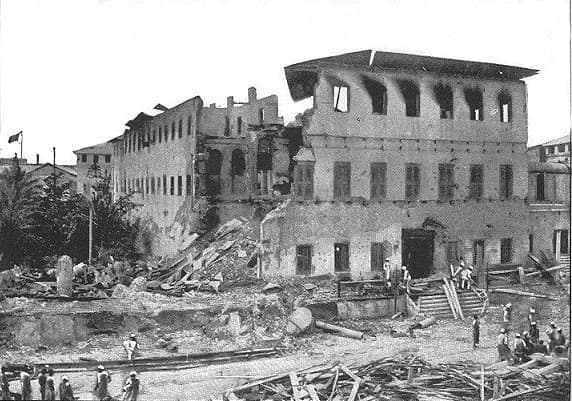
The white crenellated Palace Museum, signed Beit al-Sahel, is where most guides stop to tell the story of the war. It is worth knowing that this is not the building the navy fired on. The palace and the harem were so damaged that they were pulled down as unsafe, and the palace you walk into was built in their place in the years after the war. The ground of the old palace itself was turned into gardens.
Inside you get the sultans at domestic scale: furniture, portraits, a floor on Princess Salme, the sultan's daughter who eloped to Germany in 1866, and a floor on Sultan Khalifa bin Harub. After the 1964 revolution the building became the People's Palace, and it has been a museum since 1994.
Entry is around $5 and the visit takes about forty five minutes. We have found no official price list, so confirm at the door. Opening hours are usually given as from nine in the morning to late afternoon.
The House of Wonders and the lighthouse that became a clock tower
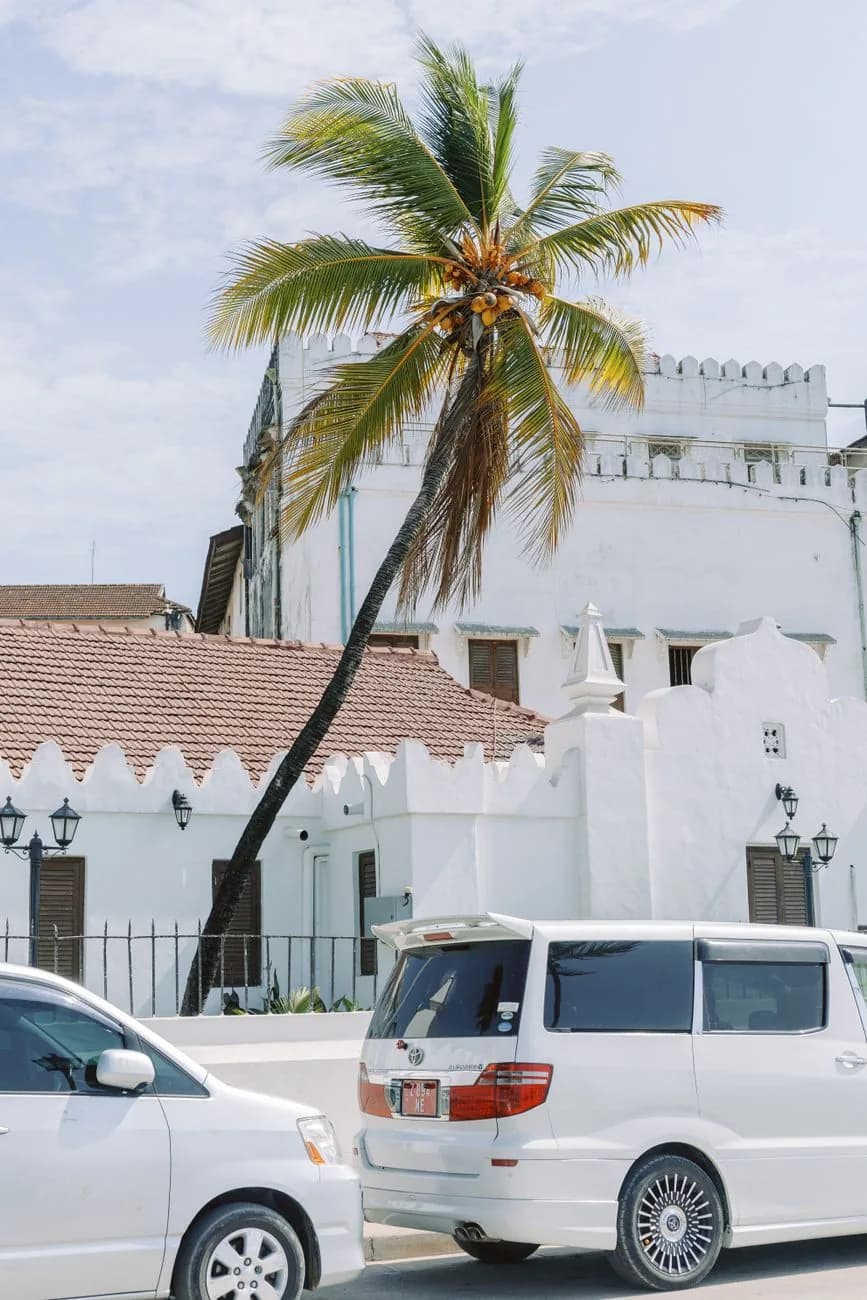
The tall white building next door is the only royal building of 1896 still standing. The House of Wonders, finished in 1883 for Sultan Barghash, came through the bombardment with minor damage. The lighthouse in front of it did not, and when the building was repaired in 1897 a clock tower was added to the facade to stand in for it. The tower you see in old photos of the seafront is a direct consequence of the war.
The tower fell with much of the facade on 25 December 2020, and the building has been closed and under reconstruction since. You see it from the street and from Forodhani, not from inside. The state of the works and the history of the building are on our House of Wonders page.
Forodhani gardens and the seafront the fleet fired on
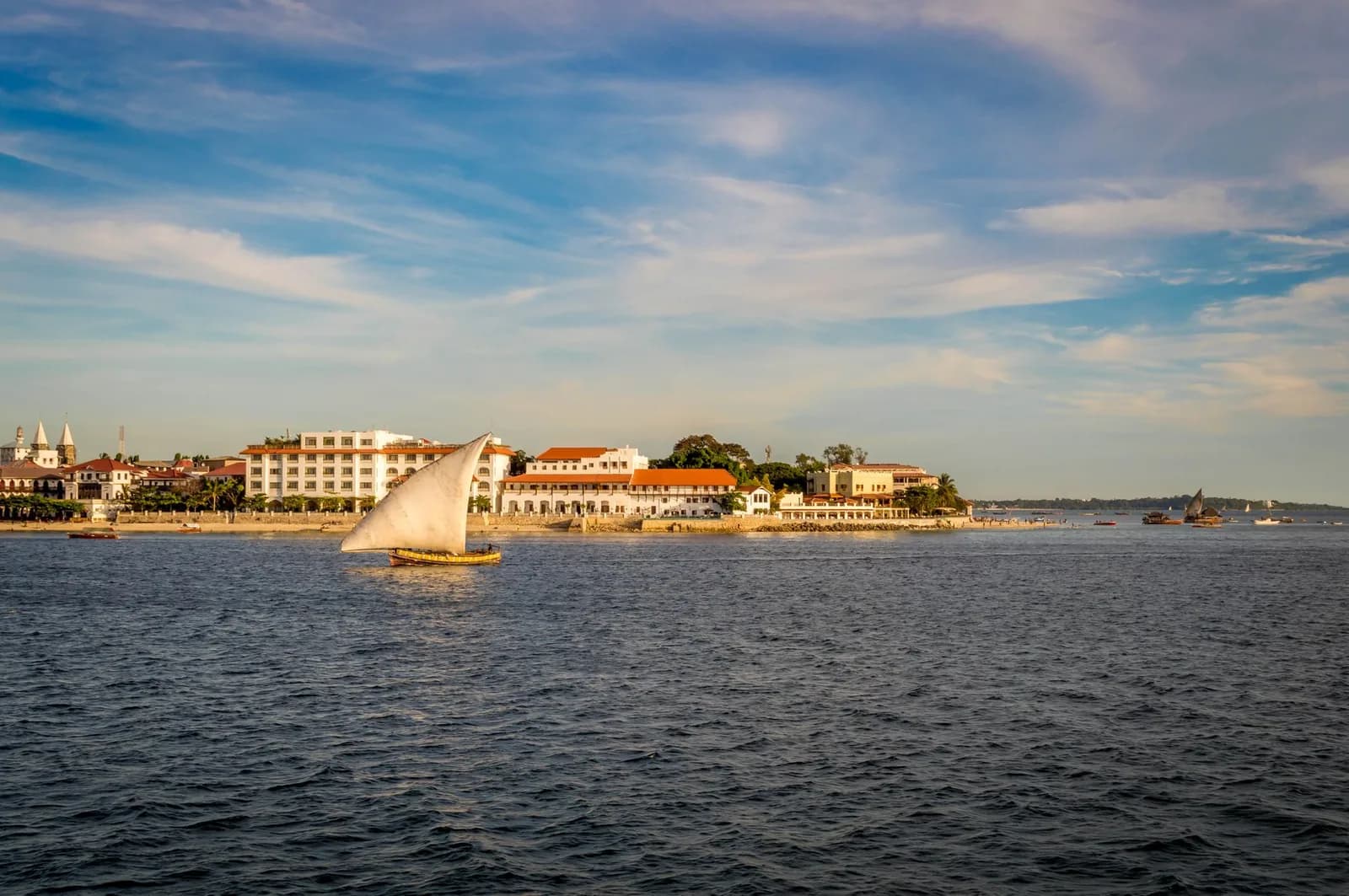
Forodhani gardens, the strip of lawns and palms between the road and the sea, is the best place to understand the war. Stand by the sea wall with the House of Wonders behind you and look out: the British ships lay off this shore, close enough that the gunners hardly needed to aim. In the evening the same strip fills with the grills of the night market.
The harbour where the Glasgow sank
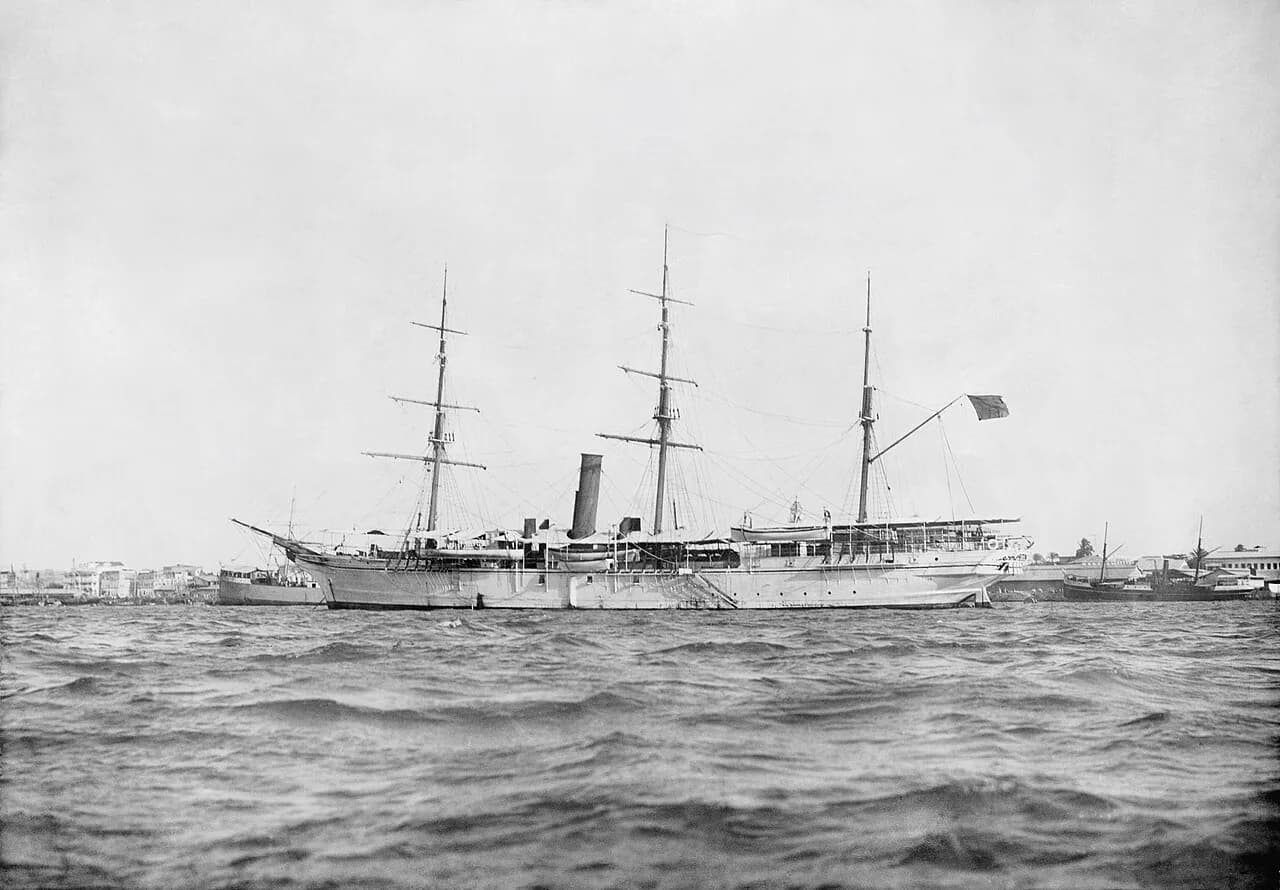
The Glasgow was a royal yacht built in Scotland in 1878 for Sultan Barghash, armed with a few small guns and a Gatling gun given by Queen Victoria. On the morning of the war she was the whole Zanzibari navy. She fired at the St George, was hit almost at once, and settled in shallow water in front of the palace with her masts above the surface. Her crew raised a British flag to show they had surrendered and were picked up by British boats.
The masts stayed in the harbour for years. In 1912 the wreck was broken up with explosives, and what is left, iron frames, teak planks, the engine and the propeller shaft, lies on the bottom. You cannot see it from the shore, and nobody runs regular dives on it. If a boatman offers to show you the Glasgow, he is pointing at water.
Is there a memorial to the Anglo-Zanzibar War in Stone Town?
We found none. No plaque, no marker on the seafront, nothing in the gardens that names the day. The story is told by guides, in the Palace Museum and on the boards of the walking tours, not on the stones themselves. If that has changed when you visit, tell us through the contact page and we will add it. Last checked 13 October 2026.
A Stone Town history tour with a guide
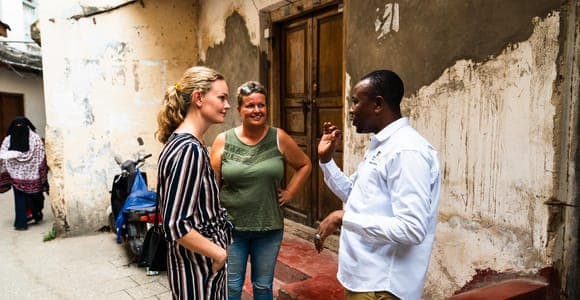
With nothing on the stones to read, a guide is the way to hear the story where it happened: the palaces, the war, the slave market and the revolution. Prices and ratings are as the partner lists them, read on the date shown below the card.
Stone Town: guided history walk
The slave market memorial, the palaces and the Freddie Mercury house.
From$25per person
Check availabilityPrices, ratings and review counts read from GetYourGuide on 27 September 2026, and indicative. These are partner links: the price is the same for you.
A 90 minute Anglo-Zanzibar War walk in Stone Town
Five stops on one road, all within ten minutes of each other, about an hour and a half with the Palace Museum. The timings are ours. Start at about four: the seafront faces west, the light is on the buildings, and you finish at Forodhani for sunset.
Forodhani gardens
10 minutes · Free
Stand by the sea wall and look out. This is roughly where the British ships lay at nine that morning, and the water in front of you is where the Glasgow went down.
The Old Fort
10 minutes · Free
Two centuries older than the war and untouched by it. Walk through the courtyard to get the scale of the seafront before the palaces.
The House of Wonders, outside
10 minutes · Free, from the street
The one royal building of 1896 still standing. The lighthouse in front of it was destroyed, and the clock tower on the facade was added in 1897 to do its job.
The Palace Museum
45 minutes · Around $5
The palace rebuilt after the shelling, later the People's Palace of the 1964 revolution. The gardens beside it cover ground the shells cleared.
Back along Mizingani Road to Forodhani
15 minutes · Free
Past the Old Dispensary and back to the gardens, ideally for sunset, when the night market lights its grills in front of the House of Wonders.
To make the walk work
- Read the ten lines above on the spot, at Forodhani, facing the sea. It takes two minutes and the rest of the walk falls into place.
- Do the Palace Museum first if you are late, since it closes in the late afternoon and the rest is outdoors.
- Cover your shoulders and knees in town, as everywhere in Stone Town.
The rest of the old town, with prices and the order a day actually takes, is in our Stone Town guide.
Why was the Anglo-Zanzibar War so short?
Because there was nothing to fight with. Five modern warships lay a short distance off a palace made largely of wood, defended by old guns and by men most of whom were not soldiers. The fire did more than the shells. The only warship on the other side was a yacht, hit within minutes of firing her first shot.
The figure of 38 minutes runs from the first shot at 09:02 to the ceasefire at 09:40. You will also read 40 and 45. Each British ship logged the end at a different time: the St George at 09:35, the Thrush at 09:40, the Racoon at 09:41, the Philomel and the Sparrow at 09:45. Count from the order to fire at nine and take the last log, and you get three quarters of an hour.
Is it really the shortest war in history? It is the shortest anyone has been able to time, which is why it holds the title. Whether a one sided bombardment counts as a war is a fair question. The British treated it as one, and so has every list since.
Why Britain and Zanzibar went to war in 1896
The war was about who chose the sultan. Under its treaty with Britain, Zanzibar's new sultan needed the approval of the British consul. When Hamad died on 25 August, Khalid did not ask for it. He took the palace and bet that the British would not shoot.
The British had their own man, Hamoud bin Mohammed, older and easier to work with. Within two days they had five warships in the harbour, the consul Basil Caveon the telegraph to London, and an ultimatum with a deadline of nine o'clock.
What happened to Khalid bin Barghash?
Khalid and about forty followers ran to the German consulate, which refused to hand him over. On 2 October 1896a German warship came in at high tide right up to the consulate's garden gate, and Khalid walked from the garden onto a boat without setting foot on Zanzibar soil, where he could have been arrested. He lived in German East Africa until the British captured him in 1916, was exiled to the Seychelles and St Helena, and died in Mombasa in 1927. His supporters were made to pay 300,000 rupees for the shells fired at them.
After 1896: the end of the Sultanate of Zanzibar
The Sultanate of Zanzibar was an Omani dynasty. Sultan Said bin Sultan moved his court from Muscat to the island around 1840, and after his death the African half of his empire became a sultanate of its own, rich on cloves, ivory and the slave trade. By 1890 it was a British protectorate. The 1896 war ended what was left of its independence.
Hamoud, the sultan the war installed, abolished slavery the following year, and more than 17,000 people were freed over the next decade. For the 67 years of the protectorate that remained, no sultan challenged the British again.
The sultans stayed, in the rebuilt palace on the seafront, until independence in December 1963. They lasted one more month.
The Zanzibar Revolution of 1964 and its traces in Stone Town
If 1896 ended the sultans' power, 12 January 1964 ended the sultans. Before dawn, 600 to 800 insurgents, mostly African and badly armed, took the police stations, the armouries and the radio. They were led in the field by John Okello, a Ugandan labourer with no military past who called himself field marshal. The government fell the same day.
Sultan Jamshid bin Abdullah escaped by sea on the royal yacht, the Seyyid Khalifa, with his prime minister. Sixty eight years after the Glasgow, the last sultan left from the same waterfront on another royal yacht. What followed was far bloodier than the war: thousands of Arabs and South Asians were killed, with estimates running from several hundred to around 20,000. In April Zanzibar joined Tanganyika to form Tanzania, which is why the island has its own president and flag but no seat at the UN, as our page on whether Zanzibar is a country explains.
Where to see the 1964 revolution today
- The Palace Museum. Taken over by the revolution and renamed the People's Palace, then a museum of the dynasty it had overthrown.
- The House of Wonders. After 1964 it became a school and museum of the ruling Afro-Shirazi Party, until the national museum moved in decades later.
- Michenzani.Across Creek Road, in the Ng'ambo district, the long prefabricated blocks of flats built from 1968 with East Germanhelp are the revolution's monument in concrete. A short taxi ride from the seafront, and a striking contrast with the coral stone of the old town.
- Revolution Day, 12 January. A public holiday across Tanzania, with official ceremonies and the Mapinduzi Cup football tournament in early January. Expect closures if you are on the island.
- Freddie Mercury. The Bulsara family were among those who left after the revolution, in spring 1964. The museum in his childhood house tells that part: the Freddie Mercury House.
The same few hundred metres of seafront hold both ends of the sultanate: the palace that lost its power to British guns in 1896, and the palace its last sultan fled in 1964. Stand at the Palace Museum gate and both stories are in front of you.
Questions people ask about the Anglo-Zanzibar War
Who won the Anglo-Zanzibar War?
Britain. The Royal Navy shelled the sultan's palace in Stone Town on 27 August 1896 until Khalid bin Barghash's flag came down, about 38 minutes after the first shot. Khalid fled to the German consulate, and the British installed their own candidate, Hamoud bin Mohammed, as sultan that afternoon.
How many people died in the 38 minute war?
About 500 people on the Zanzibari side were killed or wounded, most of them in the fire that destroyed the palace. Around 20 more townspeople died in the looting of the Indian quarter that followed. On the British side, one petty officer on HMS Thrush was badly wounded and recovered.
Why did Britain and Zanzibar go to war?
Over who would be sultan. When Hamad bin Thuwaini died on 25 August 1896, Khalid bin Barghash took the palace without the consent the British said their treaty required. Britain wanted Hamoud bin Mohammed, gave Khalid until 09:00 on 27 August to leave, and opened fire when he refused.
What is the fastest war in history?
The Anglo-Zanzibar War of 27 August 1896 is usually given as the shortest war in recorded history, at 38 minutes. Some accounts say 40 or 45, depending on whether you start the clock at the order to fire at 09:00 and which ship's log you use for the end: the British ships logged the ceasefire between 09:35 and 09:45.
Why was the Anglo-Zanzibar War so short?
Because it was five modern warships against a timber palace a few hundred metres away. The palace was a residence, not a fort, and it caught fire within minutes. The sultan's only warship, the Glasgow, was an old royal yacht and was sunk almost at once.
Can you visit the sultan's palace that was bombed in 1896?
Not the original. The palace and the harem beside it were so badly damaged that they were pulled down after the war. The Palace Museum on the Stone Town seafront is the replacement, built in the following years and open to visitors for around $5. The House of Wonders next door survived the shelling but has been closed since 2020.
Can you see the wreck of the Glasgow in Zanzibar?
No, not from the shore. The Glasgow sank in shallow water in front of the palace with her masts showing, but she was broken up with explosives in 1912. What remains, iron frames, the engine and the propeller shaft, lies on the harbour bottom and is visited only occasionally by divers.
What was the Sultanate of Zanzibar?
An Omani dynasty that ruled Zanzibar and part of the East African coast from the 19th century. Sultan Said bin Sultan moved his court from Muscat to Zanzibar around 1840, and after his death the African half became a separate sultanate. It was a British protectorate from 1890, and the 1896 war ended any real independence. The revolution of January 1964 ended the sultanate itself.
What was the Zanzibar Revolution of 1964?
An uprising on the night of 11 to 12 January 1964, a month after independence, in which a few hundred mostly African insurgents overthrew Sultan Jamshid bin Abdullah and the Arab-led government. Thousands of Arabs and South Asians were killed in the weeks that followed. Estimates run from several hundred to around 20,000. Zanzibar joined Tanganyika in April 1964 to form Tanzania.
Sources: Wikipedia, articles on the Anglo-Zanzibar War, HHS Glasgow, the Palace Museum and the Zanzibar Revolution, read on 13 October 2026, which cite the British ships' logs and the Admiralty reports. British Online Archives for the casualty figure, MIT Dome for the Michenzani dates. Palace Museum prices and hours are not published officially.