Doors still standing
Fewer than 300 to about 560, depending on the count
Oldest dated door
Reported as 1694
Two main styles
Rectangular (Omani, Swahili) and arched (Indian)
Best lanes
Shangani, Hurumzi, Kenyatta Road, Jaws Corner
Time needed
About 2 hours on foot
Cost
Free, from the street
What is a Zanzibar door?
A Zanzibar door is the carved wooden front door of a Stone Town house, and for a century and a half it was the most important thing a family owned after the house itself. The merchants of the town did business on the stone benches either side of it, the baraza, so the door was the first thing a trading partner saw. Its size and its carving told him how rich the owner was, and roughly where his money came from.
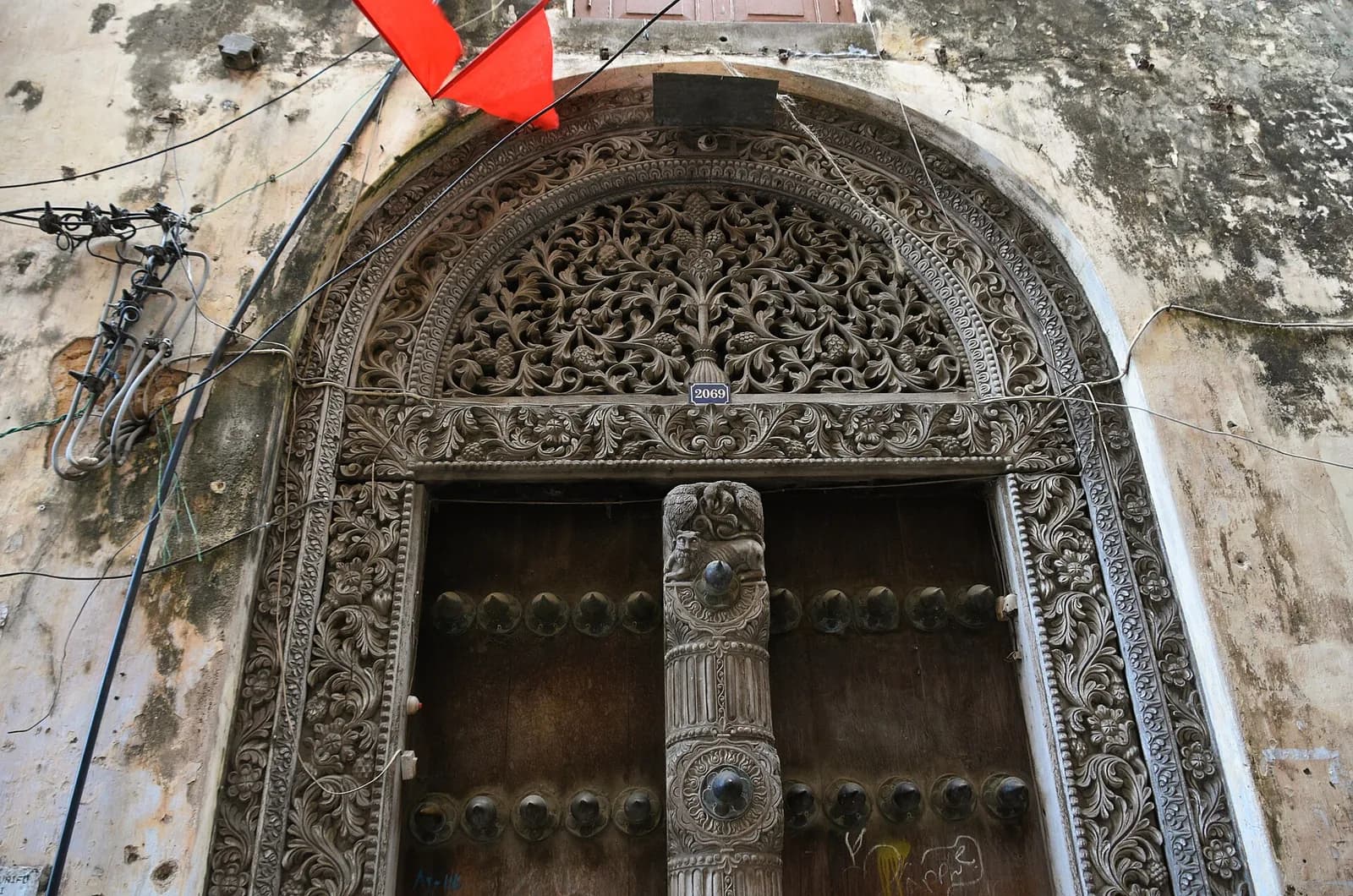
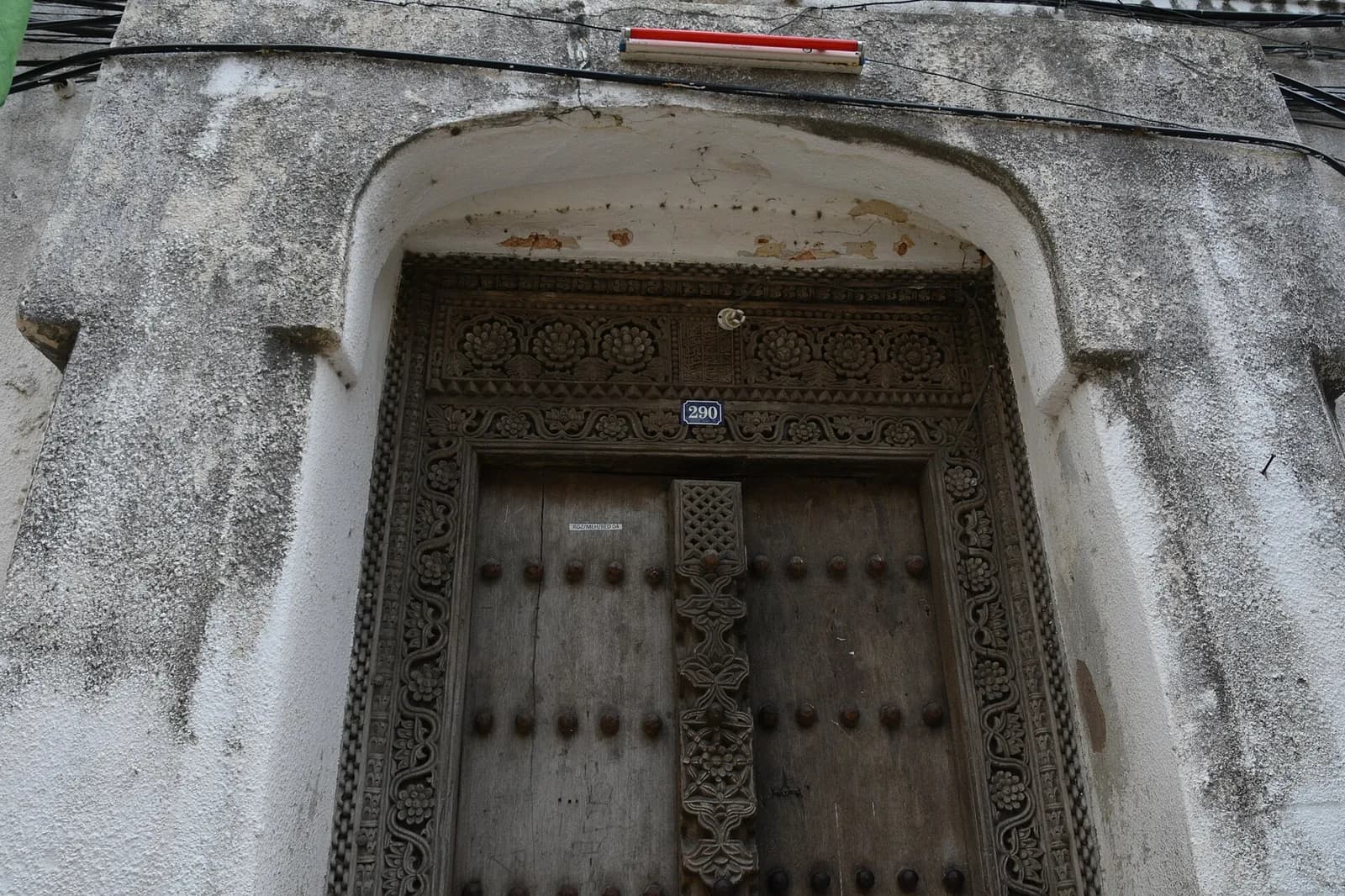
Every door follows the same build, whatever its style. Two carved side posts carry a heavy lintel, which takes the richest carving. The two leaves are plain wood, often studded with brass, and all the decoration is on the frame. Seen from inside, a thick central post is fixed to the right hand leaf, the mlango dume or male door, while the left one is the mlango jike, the female door. At the foot, a raised threshold of 15 to 20 cm keeps out water and dust from the lane.
Teak from India and Burma, local hardwoods and later mango and jackfruit were all used. The doors are a coastal tradition, also found in Lamu, Mombasa and Bagamoyo, but Stone Town has the largest number still in place, which is one of the reasons it is a UNESCO World Heritage site. Our Stone Town guide puts them in the wider half day around the old town.
Stone Town walking tours that stop at the doors
Stone Town, Local Life & Cultural Guided Tour
A guided walk through the old town's lanes, mosques and merchant houses, with the carved doors explained along the way.
- 2 to 5 hours
- Hotel pickup included
- Free cancellation
4.5(215 reviews)
from$25per person
Check prices & availability
Zanzibar Stone Town Walking Tour: History, Culture and Hidden Gems
A history and culture walk in Stone Town, cheaper than the combos, a good way to put names on the doors you pass.
- 2.5 to 3 hours
- Hotel pickup included
- Free cancellation
4.9(19 reviews)
from$17per person
Check prices & availabilityAll activities in Stone Town
Indian doors vs Swahili and Omani doors: the Zanzibar door styles
There are two families of Zanzibar door, and once you can tell them apart the walk through Stone Town becomes a reading exercise. The names vary from one author to the next, so here they are by shape.
| Rectangular (Omani, Swahili) | Arched (Indian, Gujarati) | |
|---|---|---|
| Top of the frame | Straight, heavy square lintel | Rounded arch or semicircular fanlight |
| Carving | Geometric bands, chains, fish, date palms | Flowing vines, flowers, lotus, rosettes |
| Lintel | Often a Quranic verse, the owner's name or a date in Arabic | Floral panel, sometimes an inscription in Gujarati or English |
| Metal | Fewer studs, sometimes plain iron bolts | Rows of pointed brass studs on the leaves |
| When | The older shape, before and under Sultan Said | Spread under Sultan Barghash, 1870 to 1888 |
| Typical owner | Omani and Swahili merchant families | Indian traders, and anyone keeping up with them |
Swahili and Omani doors: the rectangular frame
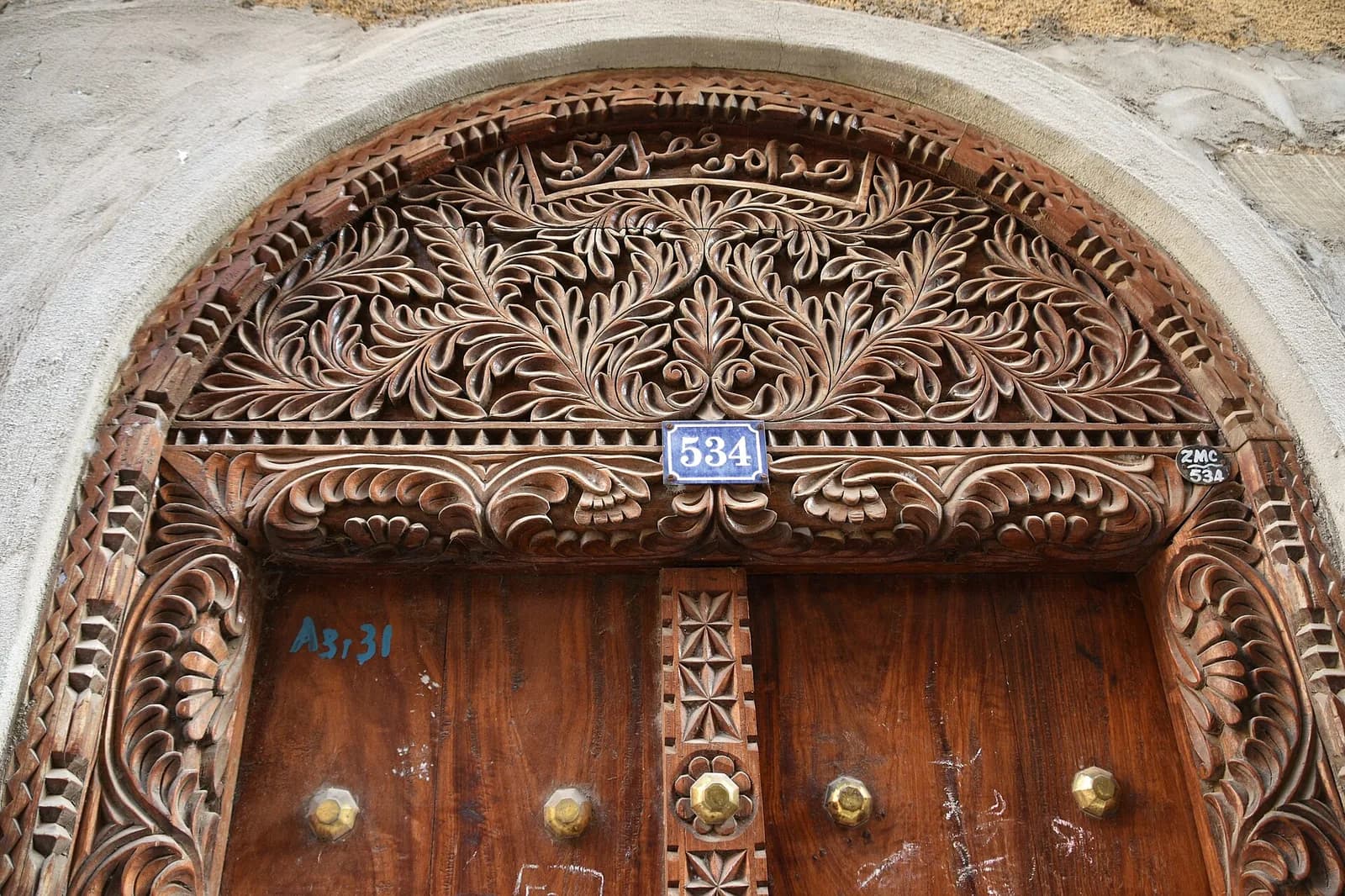
The rectangular door is the older shape. A square frame, a massive flat lintel and carving in bands: chains, geometric patterns, fish, date palms. The lintel often carries a verse of the Quran, the owner's name or a date in Arabic script, sometimes with the carver's name. You will hear these doors called Swahili, Omani or Arab, and they are the same family. The difference is mostly who commissioned them, the Swahili families of the coast or the Omani merchants who came with the sultans.
Indian doors in Zanzibar: the arch and the brass studs
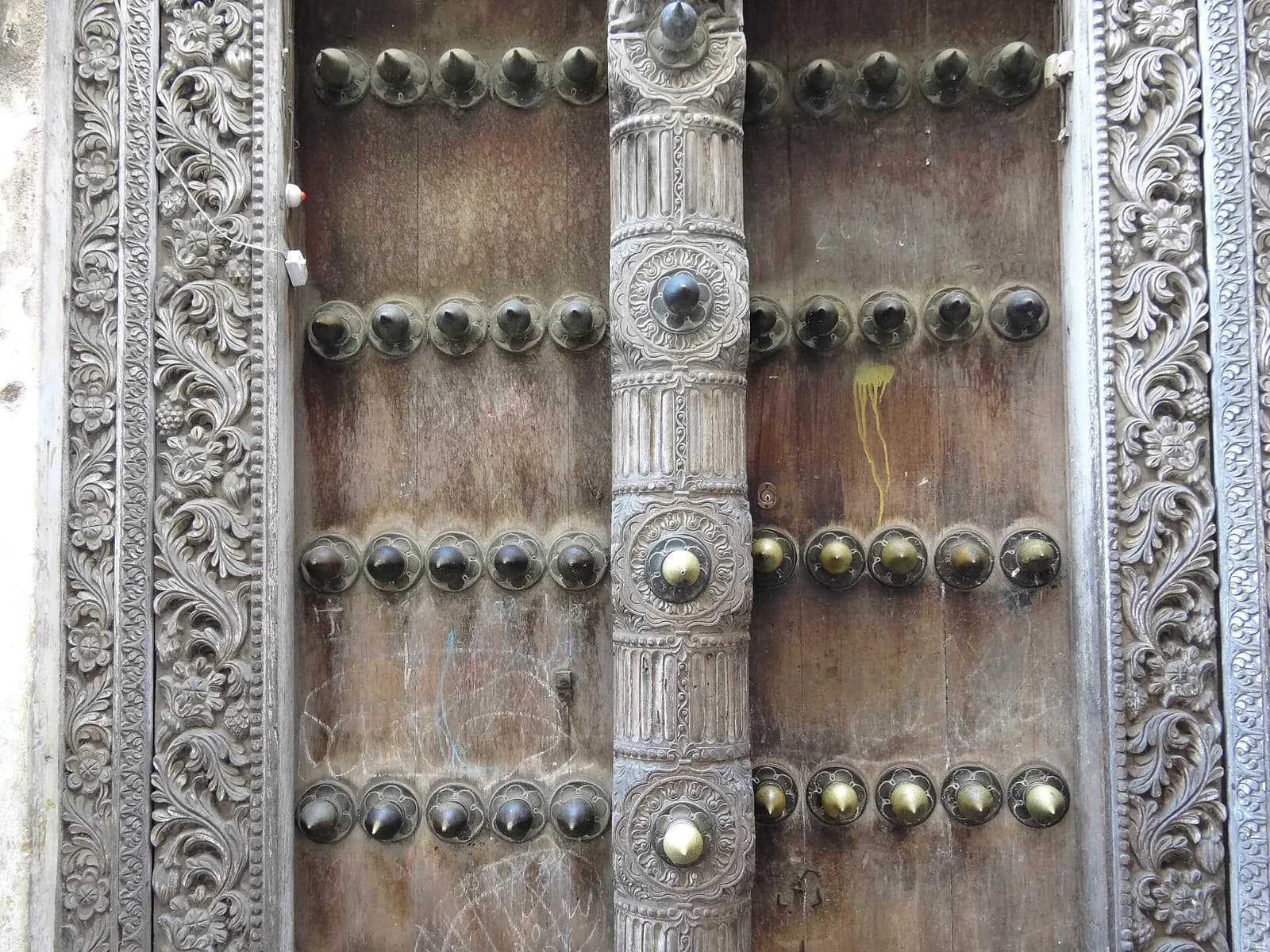
The arched door spread under Sultan Barghash, between 1870 and 1888, as Indian traders grew rich in the town. The top of the frame becomes a rounded arch or a semicircular fanlight, the carving turns into vines, flowers and lotus, and the leaves fill with rows of pointed brass studs. Beads replace the chains, a vase of vines replaces the fish.
A third, plainer type belongs to the Gujarati shops: square doors with folding panels or small shutters set into the leaves, so the shop could open onto the lane. Look for them around Jaws Corner and the bazaar. In practice many doors mix the two styles, an arched top on an Omani frame, or studs added to an old rectangular door by a later owner.
Why Zanzibar doors have brass spikes
Every guide in Stone Town will tell you the story: the spikes come from India, where they stopped war elephants from battering down fort gates. That much is the usual explanation for the Indian originals. But Zanzibar never had war elephants, and on the island the studs did two other jobs.
They held the heavy planks of the leaves together, and in polished brass they showed money. Look closely and you will see doors with plain iron bolts instead of brass cones: the same structure, a less wealthy owner. The explorer Richard Burton, who visited in 1857, put it in one line:
“The higher the tenement, the bigger the gateway, the heavier the padlock, and the huger the iron studs which nail the door of heavy timber, the greater is the owner's dignity.”
Zanzibar door symbols and their meaning
Just six motifs dominate the carving: lotus flowers, rosettes, chains, frankincense trees, date palms and fish. There is no written code for them, and no carver left one, so what follows is how they are usually read, with how much weight each reading deserves.
| Motif | Usual reading | How solid |
|---|---|---|
| Chain | Security for the house. On some doors it is read as a sign that the owner traded in slaves. | Widely repeated, not provable door by door |
| Lotus flower | Fertility and the continuity of the family | The generally accepted reading |
| Rosette | Fertility. Some guides say the number of rosettes counts the families under the roof. | First part accepted, the count is folklore |
| Fish | Fertility, or a household that lived from the sea | Several readings, none certain |
| Date palm | Abundance, and the Arabian roots of the family | Generally accepted |
| Frankincense tree | Wealth | Generally accepted |
| Rope | A seafaring trade, a dhow captain's house | Plausible, rarely documented |
| Beads, pineapple | Trade in precious stones, hospitality. More common on the later Indian doors. | Read case by case |
The chain is the one people ask about. It is read as security for the household, and on some doors as a sign that the owner dealt in slaves, which in nineteenth century Stone Town many merchants did. You cannot prove it door by door, but it is worth keeping in mind on the walk, and even more after the former slave market.
Telling an old door from a copy
An inscription on the lintel is the fastest clue. A date in the Islamic calendar and worn, softened edges point to an old door. Crisp machine regular carving and fresh varnish point to a recent one.
History of the Zanzibar doors
Carved doors on this coast are old. Portuguese visitors described them in the sixteenth century, and the oldest dated door in Stone Town is reported to carry the year 1694. Most of what you see is younger, though: 100 to 150 years old, from the boom that started when Sultan Said moved his court from Muscat to Zanzibar in the 1840s.
Cloves, ivory and slaves made the town rich, and every merchant built a house with a door to match. Under Sultan Barghash the Indian style took over, and his House of Wonders of 1883 put thirteen of these doors on the seafront. The slave market closed in 1873, slavery itself was abolished only in 1897, and the trading families who paid for the doors slowly lost their fortunes. The full timeline is in our history of Zanzibar.
Then the doors started to leave. Theft and sale abroad are the main reason the count keeps falling, and the numbers themselves do not agree: about 800 doors in a survey of the 1980s, 277 in a study by the historian Abdul Sheriff in 1998, and figures of 500 to 560 still quoted today, depending on whether a door rebuilt or moved counts. What everyone agrees on is the direction.
Where to see the best doors in Stone Town
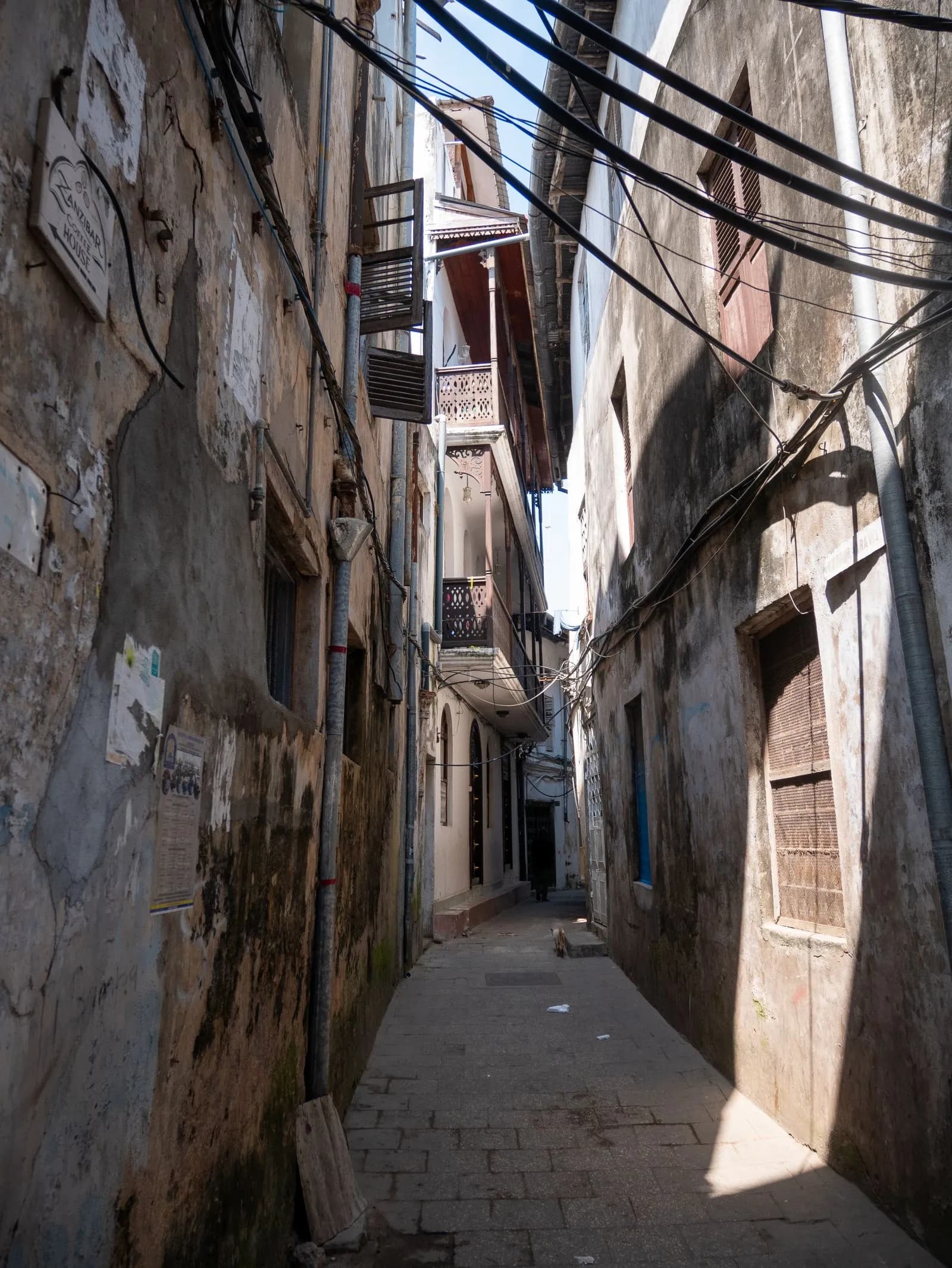
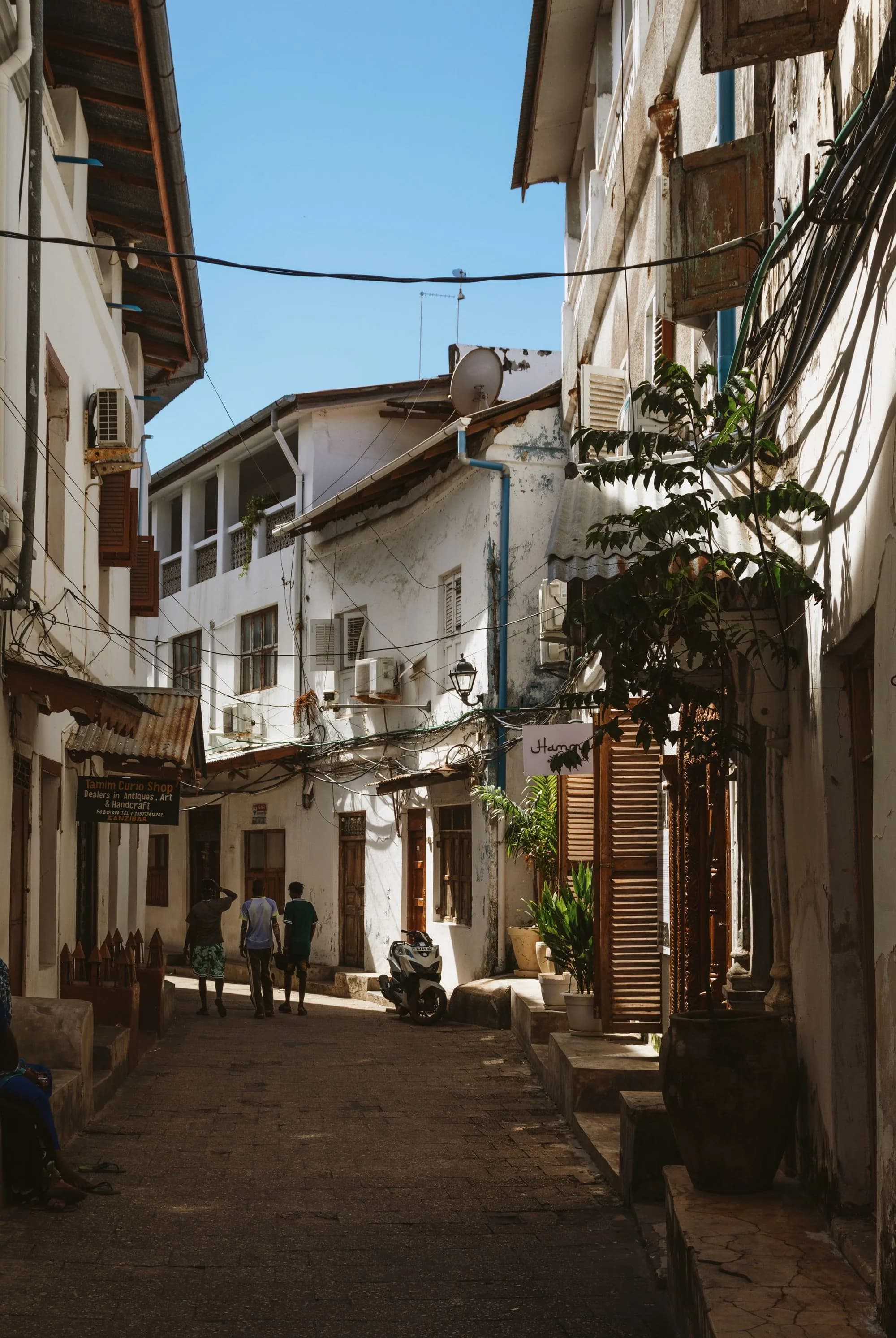
Doors are everywhere, but Shangani, Hurumzi and the streets of the Indian bazaar have the densest run. These are the ones worth looking for by name. The lanes have no usable numbers, so ask in the street: people know their famous doors.
House of Wonders, Mizingani Road
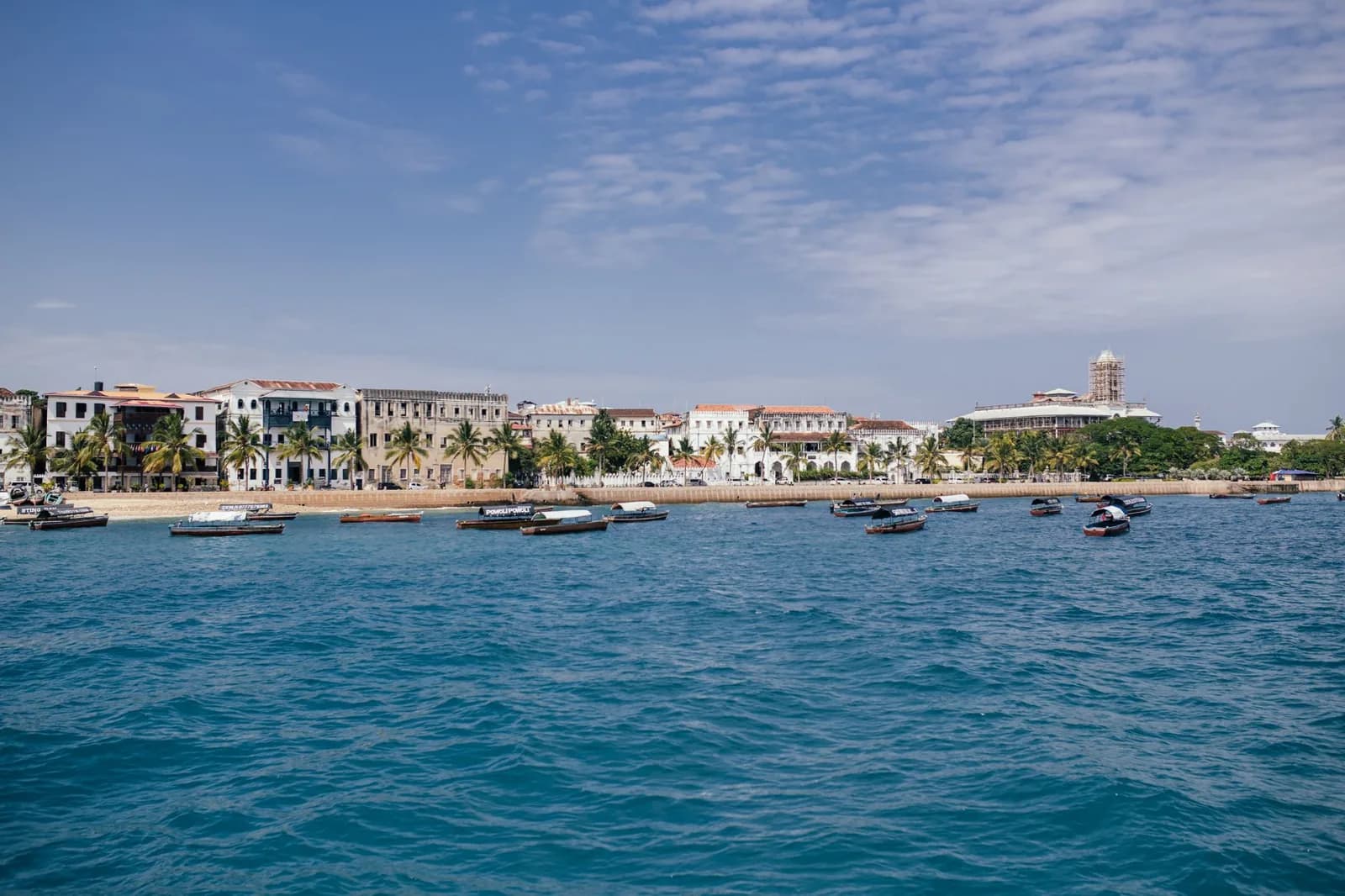
Built in 1883 for Sultan Barghash, the building that set the fashion: the facade carries thirteen carved doors in the Indian manner. It is closed and under reconstruction, so you see them from Forodhani gardens and the seafront road.
Capital Art Studio, Hurumzi
A carved door with pineapples at the foot of the frame and structural iron bolts instead of brass spikes. The studio has been here since 1930, founded by Ranchod Oza, photographer to the court of Sultan Khalifa.
Former Hindu Girls' School, Shangani
Now a tanzanite museum and shop. The arched fanlight over the entrance carries an inscription in Gujarati and in English, a rare door that says who built it in two scripts.
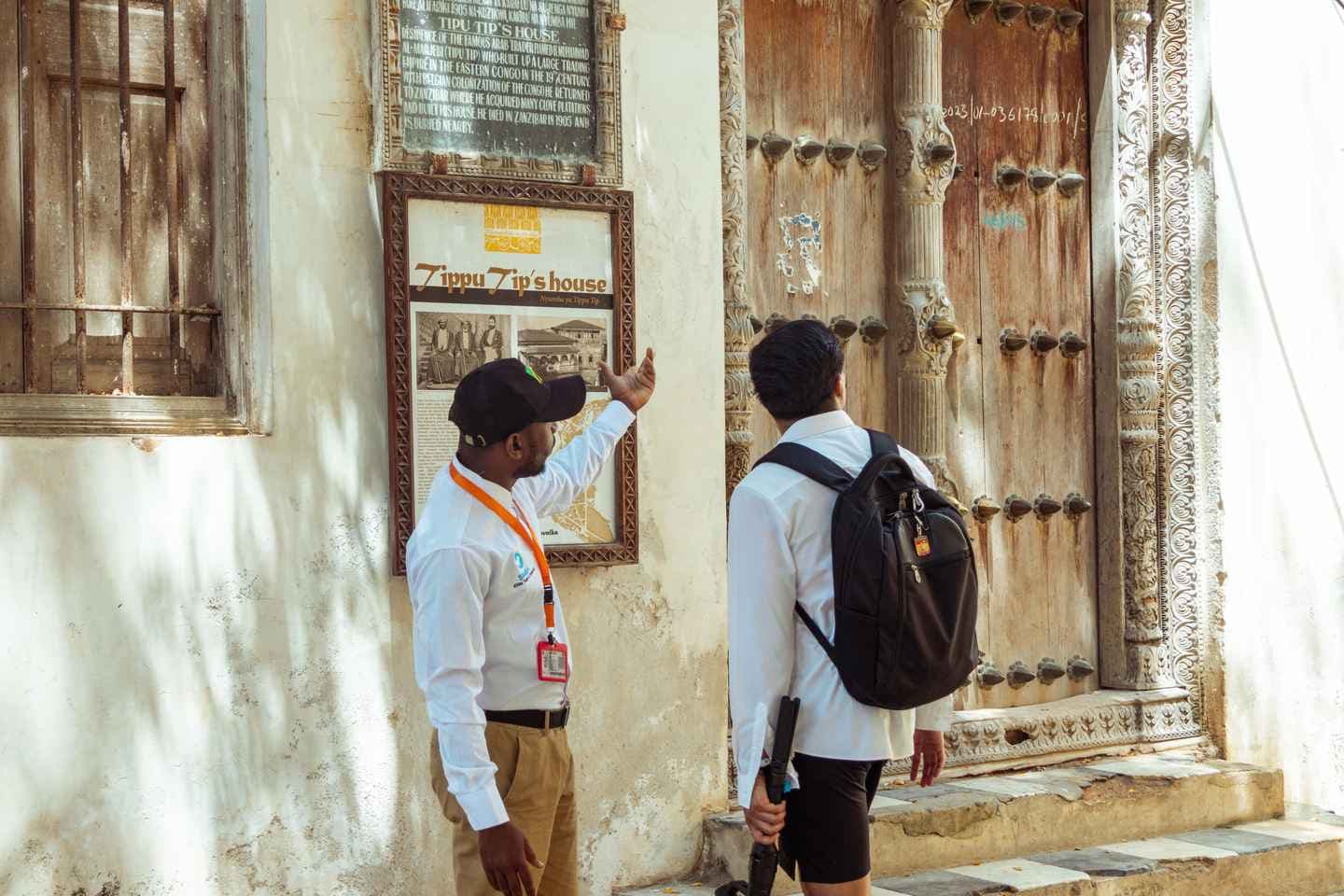
Tippu Tip House, Shangani
The house of the nineteenth century ivory and slave trader, now split into flats. The carved door and the black and white marble steps are what you come for, from the lane.
Kajificheni
A door carved with a lion and a peacock, animals you will not find on the older Omani frames. Ask for it by name, people in the lane know it.
Kenyatta Road, Bazaar Street and Cathedral Street
The streets of the Indian merchant houses. Arched doors one after another, many with their brass studs, and the best run for comparing styles without searching.
Jaws Corner
The square of benches and coffee sellers in the heart of the old town. Around it, rows of plainer square shop doors, the Gujarati trader's version, often folded open in the day.
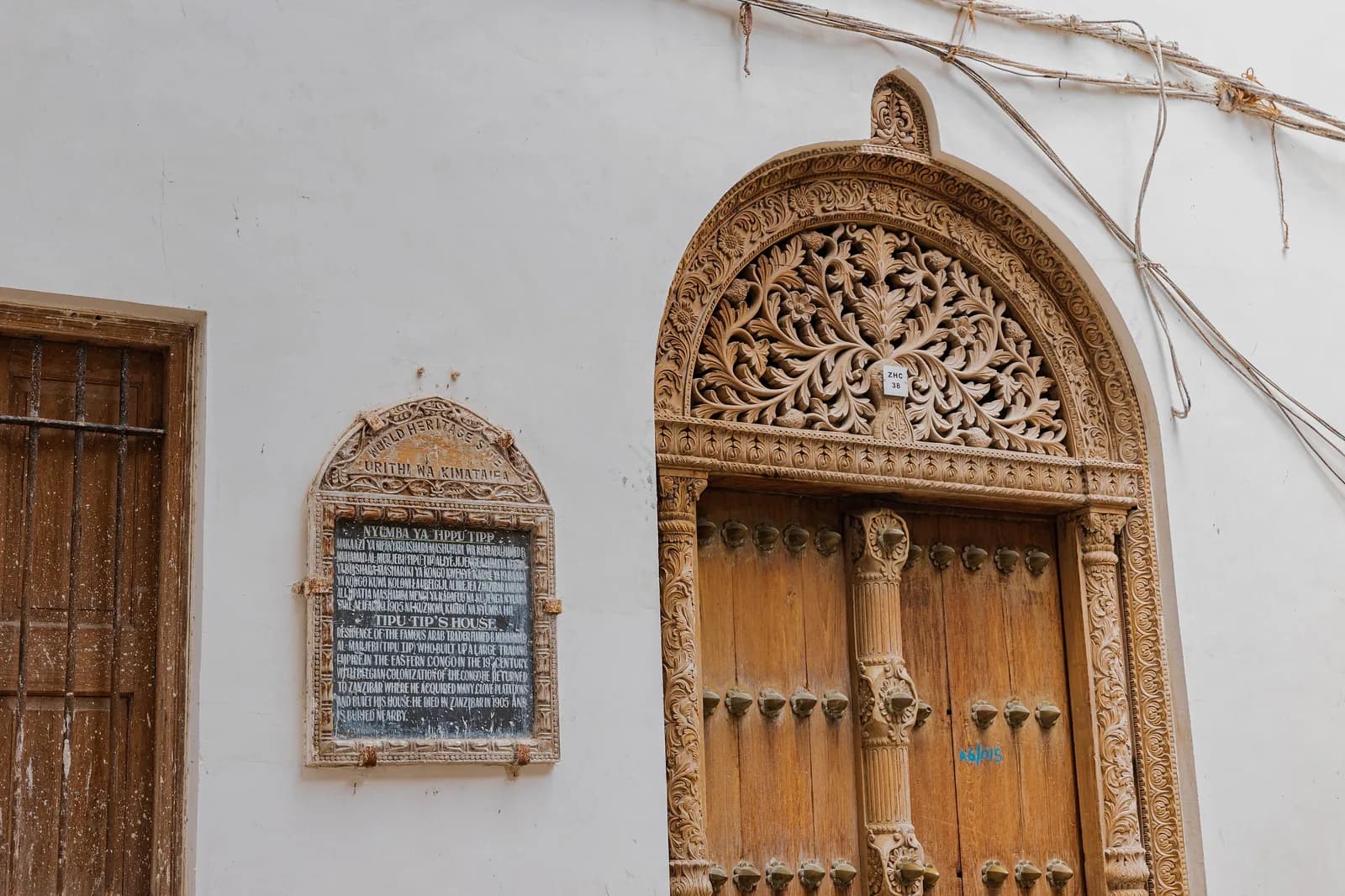
The man behind that last door has his own page: Tippu Tip and his house.
A walk past the Zanzibar doors of Stone Town
Six stops in a loop from the seafront, about two hours at a photographer's pace. Start at 7 am for empty lanes and soft light, or at 4 pm to finish at Forodhani when the grills are lit.
Forodhani gardens and the House of Wonders
20 min
Start on the seafront. Look at the doors of the House of Wonders from the gardens, then cross to the Old Fort.
Hurumzi and the Capital Art Studio
20 min
Turn inland into Hurumzi. Find the pineapple door, then look at the frames along the lane: most are rectangular, the older shape.
Jaws Corner
15 min
The Gujarati shop doors around the square, and a cup of coffee from the sellers on the baraza benches.
Kajificheni
15 min
Ask for the lion and peacock door. The lanes here are tight and the light comes down late.
Cathedral Street and Bazaar Street
25 min
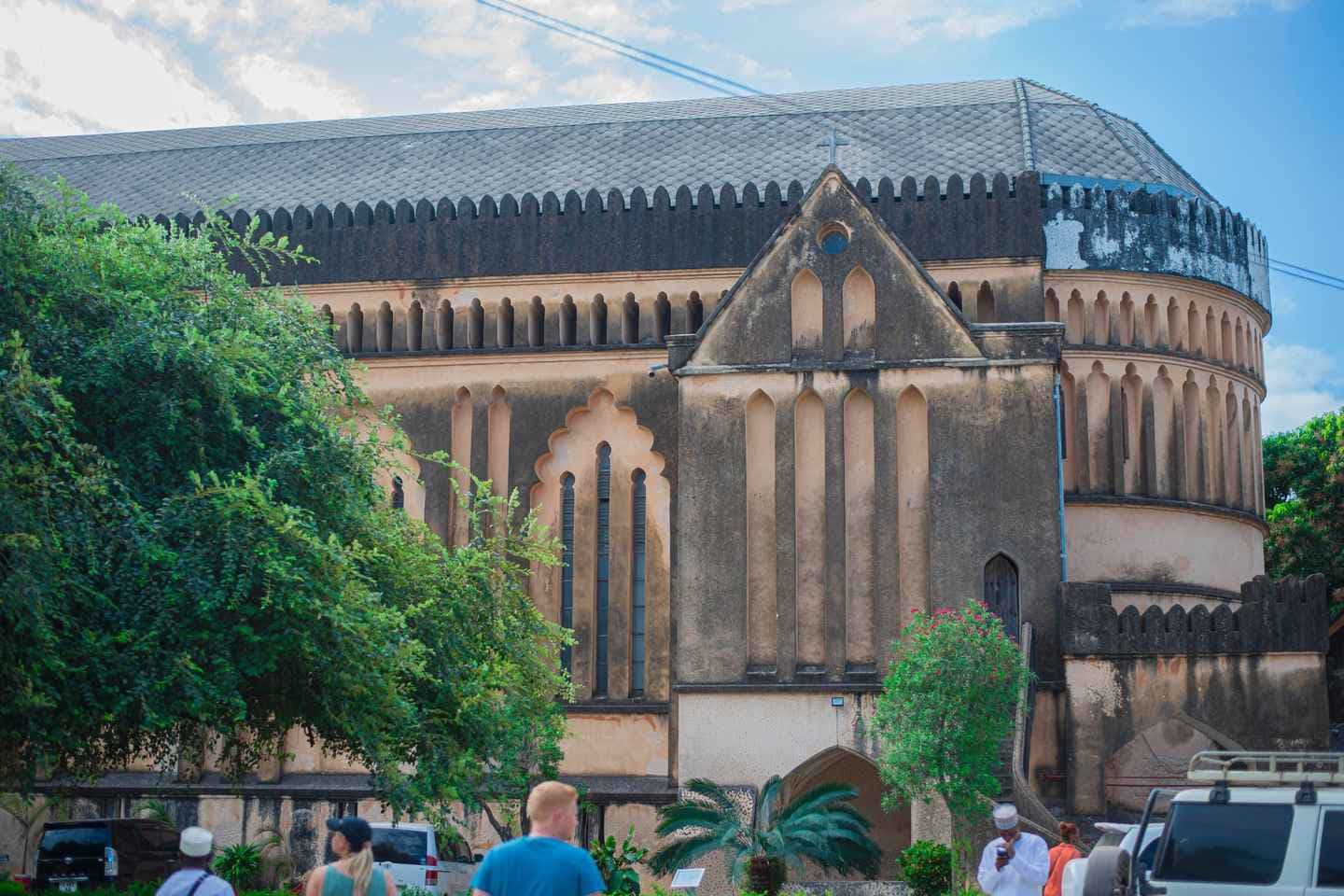
Past the Anglican cathedral, the arched Indian doors start. This is where to see the brass studs up close.
Kenyatta Road and Shangani
25 min
The tanzanite museum's inscribed fanlight, then the Tippu Tip House a few lanes further. Finish back at Forodhani for the evening food market.
Photographing the doors
Ask before you shoot into a courtyard or a person sitting on the baraza, and expect that some owners ask for a small tip. A wide lens helps in the narrow lanes, where you can rarely step back more than two metres.
The lanes are at their best before the day trippers arrive, which is a good reason to sleep in the old town: where to stay in Stone Town.
Buying a Zanzibar door: reproductions, antiques and shipping
You can take a Zanzibar door home, and most people who do buy a new one, carved to order. Workshops on the island still make full size doors in the old patterns, as well as interior doors, chests and furniture. Zandoors, for example, works with more than five workshops, ships abroad and offers visits to see the carvers at work. Prices are quoted on request, by size, wood and the amount of carving, so get a written quote with shipping included.
Antiques are another market. A dealer quoted in 2021 said an intact old door easily fetches $1,000, and that was before restoration and freight.
Before you buy an old door
Export of antique doors is restricted. Ask which building the door came from, get proof of its age in writing, and check with the Department of Museums and Antiquities in Stone Town before paying. Many doors sold as old have been taken from houses that are still standing.
For a suitcase, small carved replica doors are sold in the curio shops of Gizenga Street and around the Old Fort. Some are hand carved, many are machine cut in light wood. Turn them over: a hand carved piece is uneven at the back and heavier than it looks.
Questions people ask about Zanzibar doors
What is a Zanzibar door?
A Zanzibar door is the heavy carved wooden entrance of a house in Stone Town, the old town of Zanzibar. It has a carved frame and lintel, two plain leaves often studded with brass, a central post and a raised threshold. The door was the most important part of the house and showed the owner's wealth and standing. The same tradition is found along the Swahili coast, in Lamu, Mombasa and Bagamoyo.
Why do Zanzibar doors have spikes?
The usual explanation is that the brass spikes come from Indian fort gates, where they stopped war elephants from ramming the door. There were never war elephants in Zanzibar. On the island the studs held the planks together and, in polished brass, showed that the owner had money. Cheaper doors used plain iron bolts.
What do the symbols on Zanzibar doors mean?
Six motifs dominate: lotus flowers, rosettes, chains, frankincense trees, date palms and fish. They are usually read as fertility, abundance, wealth and protection, and a chain is sometimes read as a sign that the owner traded in slaves. There is no written code, so these are common readings rather than rules.
How many carved doors are left in Stone Town?
Nobody agrees. About 800 were counted in the 1980s, a 1998 study counted 277, and other sources give about 500 or 560 today, depending on what is counted as an original door. All agree that the number keeps falling, mostly through theft and sale abroad.
What is the oldest door in Zanzibar?
The oldest dated door in Stone Town is reported to carry the date 1694. Most of the doors you see are 100 to 150 years old, from the nineteenth century trading boom, and only a handful are close to 300 years old.
Can you buy a Zanzibar door and ship it home?
Yes, a newly carved reproduction. Workshops in Zanzibar make full size doors to order and arrange shipping, with prices given on request. Antique doors are a different matter: export of old doors is restricted, so ask for written proof of age and origin and check with the Department of Museums and Antiquities before paying.
What is the difference between Indian and Swahili doors in Zanzibar?
Swahili and Omani doors are rectangular with a heavy straight lintel and geometric carving, and they are the older shape. Indian doors arrived later in the nineteenth century, with a rounded arch, flowing floral carving and rows of pointed brass studs. Many doors in Stone Town mix the two.
When is the best time to photograph the doors of Stone Town?
Early morning, before about 9 am, and the late afternoon. At midday the lanes are either in hard shade or harsh light, and the streets are busier. Ask before photographing inside a courtyard or a person sitting on the step, and expect that some owners ask for a small tip.
Sources: The World of Interiors, February 2017, on the motifs, the House of Wonders doors and the Capital Art Studio. The Citizen, 13 May 2025, on the Indian doors of Stone Town. African Arts 17(4), 1984, on door structure. Richard Burton, 1857. Fumba Town, October 2021, for the antique price.
Photos via Wikimedia Commons: Richard Mortel, CC BY 2.0 (header, rectangular door, carved frame), Adam Jones, CC BY-SA 2.0 (brass studs).